Showing posts with label handloading. Show all posts

Monday, November 02, 2026

A Homemade Powder Dipper

 Reloaders have made their own dippers for measuring powder charges for decades. I made a dipper from an empty .22 Long Rifle case and some copper wire, and tried it out with three different fast burning pistol powders: Accurate No.2 (AAC-2), Alliant Bullseye, and Hodgdon Titegroup.


I was hoping to get a dipper that would throw very small charges suitable for use in small, low pressure cartridges like .32 S&W Long. However, the charge weights are a bit higher than I'd wanted.

To measure, I threw 10 charges of each powder and weighed them individually on a Frankford Arsenal digital scale. I then took the average of those 10 charges.


My results (It is likely that yours will vary, see below!):

  • AAC-2: 3.08 grains
  • Bullseye: 2.98 grains
  • Titegroup: 3.68 grains


To put these into perspective, with AAC-2 or Bulleye, these charges are good for loading .38 Special 148 grain wadcutters. They'd be light loads under a 158 grain semiwadcutter or round nose bullet, because those aren't seated as deeply in the case, thus lowering chamber pressure.

In .32 H&R Magnum, 3.0 grains of AAC-2 would be a mild load with a 100 grain lead bullet. Likewise, 3.0 grains of Bullseye would be a mild load with 96 - 100 grain lead round nose bullet.

The Titegroup load would approximate a .38 Special (not +P) 158 grain service load. It could also be used to load 85 grain JHPs in .32 H&R Magnum.

VERY IMPORTANT WARNING:

Before you rely on this data consult with one or more loading manuals. Use at your own risk.

If you try this make sure to create your own charge table. The amount of powder a dipper will measure will vary depending on the case used, the manufacturing lot of the powder, and your technique.

Since this dipper measures out charges larger than what I was after, I plan to make another one with a .22 Short case to see what that gets me. 

Tuesday, February 17, 2026

Loaded Some Reduced Recoil .30-30s Today

Today I loaded up 50 rounds of .30-30 (.30 WCF) reduced loads with lead bullets and Unique powder. These will primarily be fired in a late 1940s-vintage Stevens 325-B bolt action.


The bullets were 1990s-vintage Alberts Scheutzen Plinker 154 grain swaged lead from my late father's stash. I used some Federal No.210 large rifle primers I bought back then when I was loading .30-06 for shooting in an M-1 Garand in Service Rifle competition back in the 90s. I haven't loaded much high power rifle since then.

After seating but before crimping:


Aesthetically, I really like the retro look of these loads.

I chose a mild charge of 9.0 grains of Unique, which should drive the bullet to around 1200 - 1300 FPS, but I'll run some over a chronograph to be sure. I've see data for 150 grain lead bullets with up to 11.0 grains of Unique.


I also inventoried my .30 caliber cast bullets. I have a box of Lasercast 170 grain RNFPs. They are designed to use a gas check but those aren't installed. I  have a bag of gas checks which I can add using my Lee sizer, and did that for 20 bullets. I also have some Lee 178 grain RNFP gas checked bullets from MOD Outfitters, sized .310. I should be able to drive the gas checked bullets close to 2,000 FPS. I'll try using Winchester 748 powder or IMR 3031 for that.

Saturday, December 14, 2024

A Rossi .410 Single Shot

A few weeks ago I got to shoot an old H&R folding .410 shotgun that belongs to a friend, and instantly got a bad case of the wants. I offered to buy it from him but he's not selling, and I can't blame him. He owns some property and it would be a perfect piece for taking care of varmints in his garden or to tote while he's walking his land.

So, I got to looking for a .410 break barrel on Gunbroker. I lost an auction for a nearly mint condition Stevens 94 but found a gently used Rossi SS4112811. I picked it up from my FFL a couple days ago and it's in even better shape than described in the listing. It's basically new old stock. The only thing that was missing was the OEM cable lock, which is no loss IMHO. This model is no longer listed on Rossi's website.


The barrel is 28" long with a modified choke, which is preferable for my needs to the full choke most .410s have. I think, anyway. I need to pattern it.

The gun weighs about 3.8 lbs. It feels like a toy but it means that you can carry it all day.

Rossi's method of takedown is good. The forearm is held on by the same screw which the front sling swivel is attached to. It's captured so it can't be lost.

Like the H&R single shots made in the past several decades the Rossi has a transfer bar, allowing it to be safely carried loaded with the hammer down. It also has a manual hammer blocking safety mounted on the left side of the receiver. At first my reaction was to regard this as superflous but it will allow me to hunt with the gun cocked, much as one would with a hammerless double or a pump gun. I'm left handed so the safety is easy to push off with my trigger finger. A righty could use his thumb, but for once this is a gun feature that's actually more southpaw-friendly.


The plastic furniture is hollow, which got me thinking about using it to store emergency supplies. There's plenty of room in the stock to hold a bore snake or maybe a collapsible cleaning rod, and a bottle of oil, or a ziplock bag with some shells. The forearm is hollow with reinforcing ribs. If I cut one out it could hold shells. I may just stash some fire starting gear in it.


Since the 2020 pandemic, .410 ammo has been scarce on gun shop shelves, and most of that seems to oriented for defensive use in Taurus Judge or S&W Governor revolvers. My FFL only had shells loaded with No.9 shot. However, I've been able to find a variety of .410 ammo online in both 2.5" and 3" length, and have acquired several boxes to experiment with, ranging from No.9s to No.4s to buck and slugs.

UPS should be bringing a stock cuff for ammo and a repro M1 Carbine sling today.

I'm also planning to fireform some .303 British empties into all-brass shells, using instructions posted elsewhere by @Outpost75. The gun closes on the .303 cases but it's a little tight so first I'll sand a thou or so off the case heads. I also have a box of Magtech 2.4" brass shells on the way from Ballistic Products along with suitable cards and wads. Next weekend there's a gun show and I'll try to pick up some Lil-Gun and/or H-110/W-296 to reload with. Apparently, 2400 is also good for reloading .410 but lately it's pretty much unobtanium. And I can always use the Holy Black.

I have several 12 and 20 gauge shotguns so this acquisition wasn't a need, but it should be fun to experiment with.


Tuesday, July 16, 2024

Prime Day Deal on the Frankford Arsenal Hand Priming Tool

It's Prime Day at Amazon and something that's on sale is the Frankford Arsenal Hand Priming Tool. I bought one a couple months ago and have primed at least 500 cases with it. Compared with the Lee Hand Priming Tool I used for years, the FA is much better built, robust, and also allows adjusting the primer seating depth.

Using the Lee tool I'd usually lose 1 or 2 primers out of 100 due to them seating sideways. I haven't lost one primer yet with the Frankford Arsenal tool.

Normally it's priced at $79.99 but for Prime Day it's $59.99. It's worth it at the normal price. The Prime Day price is a great deal.

Sunday, May 12, 2024

Cast Bullets Using the Lee TL358-158SWC Mold

Over the past month I've done a couple bullet casting sessions, mostly making 158 grain (nominally) lead semiwadcutters in a 2-cavity Lee TL358-158SWC mold. I also cast a couple hundred .490 round balls for my .50 caliber muzzleloading rifles.

Bullets cast from this Lee mold have a nice reputation for accuracy in .38 Special and mild .357 Magnum loads. I also like that the design incorporates a wide meplat that will perform well if I shoot anything besides paper or steel with it.

This image swiped borrowed from the Lee Precision website shows was they look like:


Aside from that wide meplat, the tumble lube design makes for easy casting and prep. I cast them from soft alloy since I'll be keeping them under 950 FPS. I used pure lead with some old, unneeded cast bullets added to the mix to add some tin for better mold fill-out and stretch the melt a little. I can still scratch the bullets with a thumbnail, however.

To lube, I put a batch in a small container and then dribble some Lee Liquid Alox on, then mix them all up until the lube is evenly distributed over all the bullets. LLA comes out of the bottle brown but you only need a very light coating, such that the bullets are still mostly silver colored.

You can also thin the LLA with some mineral spirits to stretch it out and speed drying.

White Label Lube's Liquid Xlox is a substitute for LLA and may be more cost effective than LLA, but I haven't tried it.

The wet bullets are then set on a sheet of wax paper to dry. They're good to go in about 12 hours.


Tumble lube designs are also good for powder coating if that's your thing.

Lee sells several other tumble lube designs, and I've read on forums devoted to cast bullet shooting that others get good results tumble lubing conventional designs as well.

I don't size the bullets before loading. Instead, I make sure that my case mouths are adequately flared. I seat them, then in a separate operation I run the loaded rounds through a Lee Factory Carbide Crimp Die, which also sizes the case down to factory dimensions. Thus, if the bullets are a bit oversized and caused a bulged case, it gets sized back down to the correct dimensions.

Yesterday I put 50 of the Lee bullets through a 3" Model 64, loaded on top of 4.1 grains of HP-38 in mixed brass, with CCI small pistol primers. In a 4" barrel and depending on barrel/cylinder gap, this load should run around 850 FPS +/-. It's probably closer to 800 from a 3" tube.

There was very minimal leading, if any. The lube leaves a bit of soot on the gun and is smokey. Many peopple don't like either but to me it's a part of shooting a revolver. The soot wipes right off with a rag anyway.

My late father's favorite .38 Special handload was a 158 grain LSWC, usually Remington swaged bullets, on top of 4.3 grains of HP-38 in mixed brass and usually with Winchester small pistol primers. It's very accurate but when I got the S&W Model 15 that he shot a lot of these through I had to remove quite a bit of leading. The front edges of the cylinder were actually covered in lead deposits. He shot a lot and got lazy with cleaning in his later years, what can I say?

The next batch of these I load will probably be a bit slower, with either 3.9 grains of HP-38, 3.5 grains of Bullseye, or some other charge. The paper or steel targets I shoot won't know the difference and recoil will be a little less, which is good for my hands.

I've recently acquired a pound each of Accurate No.2, Hodgdon Titegroup, and Winchester 244, none of which I've previously used. The No.2 and Titegroup should good for light target loads while the 244 is closer to Unique and may be good for heavier loads suitable for woods carry.

IMHO, bullet casting is not only fun but it's a good prep. Yes, it's time consuming but it helps insulate you from component shortages that happen every election cycle or artificially generated panic. Cast bullets are old fashioned but remain effective projectiles.

Wednesday, February 22, 2023

Converting Rifle Brass to Use No.209 Shotshell Primers

AKA, “Yet another reason to have a small lathe.”

Obligatory disclaimer: We don’t guarantee that these will be safe in your rifle or with your components. Do this at your own risk.

The cartridge cases converted using this method are NOT safe to use with full loads. Read that again. They are only safe to use with low pressure reduced loads. Use at your own risk.

My friend N. has recently delved into shooting his M-1891/59 Mosin-Nagant and No.4 Mk.I Lee-Enfield with "mousefart" loads. These are even less powerful than Ed Harris’s “The Load” of 13 grains of Red Dot under a 150 - 180 grain bullet. N. is loading a 115 or 125 grain cast bullet on top of 5.0 grains of Bullseye. (His first try in 7.62R used 6 grains of Bullseye but accuracy was horrible. Backing off to 5 grains shrank the groups.)

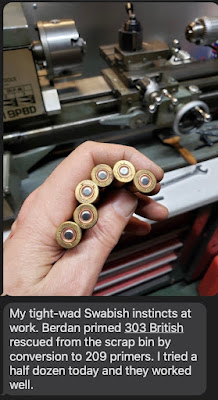
He has a good stock of No.209 shotshell primers but not a lot of large rifle primers. He also has a lathe in his basement workshop, as you can see in the picture. It’s an older Jet unit with a 7” swing (not sure how long it is). He took some Berdan primed .303 cases that he’d stashed away and drilled out the primer pockets so they will accept No.209 primers.


Per N., he used three drill bits to modify each case:

"Center drill to keep main drill from following the firing pin dent, letter C for the main body, 21/64 to countersink the flange on the battery cup.  Be careful!  My Fiocchi primers are .002" larger than my Cheddite, and I understand the Cheddites are larger than most Yankee brands."

So measure the No.209 primers you have and pick drill sizes to match.

We haven't tried this with Boxer-primed brass but I don't see why it wouldn't work. This project was primarily to make something useful from what otherwise would be trash.

Something else to consider is how your rifle will handle escaping gas if something goes wrong. I have been present when someone experienced complete case head separations in a No.4 Lee-Enfield and another time in a Mosin-Nagant. The Lee-Enfield shooter didn't notice anything awry until he opened the bolt. The Mosin shooter got gas back in his face but was uninjured because he wore eye protection.

Also note that a lot of milsurp .303 and all 7.62x54R were corrosively primed. Make sure to clean your rifle accordingly when shooting that ammo. You also need to rinse out the brass with water if you plan to reuse it. (The No.209 primers are not corrosive. I'm only referring to the initial firing with the original primers.)


Sunday, April 24, 2022

Full Charge Wadcutters

Inspired by this article by C.E. (Ed) Harris, earlier this month I loaded up a batch of full power .38 Special wadcutters. Wadcutter ammo in .38 Special is usually loaded light for target shooting. However, when loaded to the same power level as .38 service loads, wadcutters are effective on game and for self defense use. Expansion is minimal but they penetrate very well and cut a full-caliber hole the entire way.

The loads I shot today consisted of:

Note that Ed Harris uses 146 grain double end wadcutters cast from a Saeco mold. I chose the button nose design cast from a Lyman 35891 mold because they may offer slightly better accuracy at long range (i.e., over 50 yards). The difference is probably minimal, however. The bevel base does make loading them in the brass a little easier.

Something interesting to note in that reading various forum posts over the years about .38 wadcutter loads, it appears that these bullets virtually always give best accuracy when loaded to full power.

In any event, my Smith & Wesson Model 15-3 likes this load. This 12-shot group was fired today from about 10 yards, shooting double action:


I caused the 2 flyers.

I'm going to load up a bunch more of these rounds.

Sunday, November 22, 2020

Converting .38 Special Brass to Accept Large Pistol Primers, Part 2

I modified another 5 cases today in my lathe. I loaded those and the 5 I modified yesterday with 4.4 grains of Unique, a CCI LPP, and a .358 160 grain LSWC from Matt's Bullets. I also loaded another 50 in unmodified brass using Sellier & Bellot SPPs.

The round on the left is an unmodifed case. The 2 on the right are modified.


You'll note that there is still plenty of brass around the large primer.

I should be able to try them next weekend.

Saturday, November 21, 2020

Converting .38 Special Brass to Accept Large Pistol Primers

One of the things I've preached on this blog is that when times are good, you should stock up on items that will be hard to get during a panic. One of those things is a good supply of primers if you're a reloader.

Last Fall, I bought a case of 5,000 CCI Large Pistol Primers. I use LPPs for loading .38-40, .44-40, and Magtech brass shotgun shells. If I ever get around to loading .45 Colt I'll use LPPs for them as well.

For loading .38 Special, .357 Magnum, 9mm, and .32 S&W and .32 S&W Long, and .32 H&R Magnum, I need Small Pistol Primers.

Guess who forgot to stock up on SPPs before the panic hit? Guess what is virtually impossible to find now?

<sigh>

Before the COVID-19/race riots/election year panic set in, I thought I had around 5K SPPs. In reality, I have about half that.

Shit.

So, a few weeks ago I wondered if it would be possible to convert .38 Special brass to accept LPPs. I did some research online and found that in fact, there used to be factory loaded .38 and .357 ammo which used LPPs.

Since LPPs may contain a bit more priming compound than SPPs, if you do this, reduce any maximum or near-max loads by 10% and work on up.

This page has a chart listing the minimum and maximum dimensions of both primers and primer pockets.

To modify the primer pockets I used a .210" chucking reamer with a stop collar on it to set the depth. The stop collar was made from 1/2" 6061 aluminum rod. It's held in place with an M4 screw I had in one of my miscellaneous parts bins.


To use it, I chucked deprimed a .38 Special case in the lathe and held the reamer in a drill chuck in the lathe's tailstock.


Note that because in a lathe the workpiece rotates, not the cutting tool, I don't need to be concerned about the stop collar being unbalanced due to the set screw sticking out.

I found that because of the small clearances, brass chips built up between the head of the case and the collar. I had to withdraw in several times per case to clear the chips with a brush and pick. It was slow going.

But eventually, I converted five cases to accept large pistol primers. To test, I seated CCI LPPs. They seated easily, maybe a little too easily. It might be better to use a .209" diameter reamer because .210" is the maximum for large primers.


I plan to do another 5 cases tomorrow and then load them will mild charges so I can test them on my next trip to the range.

During the Obama-era panic, some of the primer shortfall was made up by imported primers. I'm hoping that the same will happen this time around.

And you can be damn sure I won't be caught short again.

Sunday, August 16, 2020

Black Powder 20 Gauge Shells with Patched Round Balls

  Today I loaded up 25 rounds of 20 gauge shells for potential use as short range deer hunting loads. They consist of:

  • Magtech brass cases
  • Federal large pistol primers
  • 80 grains of Goex 2Fg black powder
  • Ballistic Products nitro card
  • Ballistic Products fiber cushion wad
  • 2 x 0.010” patches prelubed with Wonder Lube
  • .575 round ball
  • Ballistic Products over shot card sealed with Duco cement
Before I settled on the patch/ball combination I check it for fit in my H&R Topper’s modified choke. With only one patch I could push it through with hand pressure. With two patches I needed to tap it through using a mallet, but it required less pressure than a typical tight fitting PRB in a muzzle loading rifle.


Waiting for the Duco cement to dry:


Monday, July 27, 2020

Black Powder Shotgun Go Boom!

A few years ago I loaded up some black powder 12 gauge shotshells in Magtech all-brass hulls, that I bought from Ballistic Products. This exercise was inspired by a video on the Survival Russia YouTube channel, which has since been taken down in accordance with their rule prohibiting videos that show how to load ammunition.


(The picture is a frame grab from an iPhone video.)

I did a few variants:

1-1/4 oz. of #7.5 shot on top of a compressed column of sawdust (in lieu of a cushion wad)
1-1/4 oz. of #5 shot on top of sawdust.

Also, some of the same payloads on top of lubricated wool felt wads. (I have a supply of such homemade wads for use in my Euroarms Magnum Cape Gun percussion 12 bore.)

And a patched .690 round ball on top a couple lubricated felt wads. All were loaded on top of 80 grains of 3Fg.

I tested one each of the #7.5 and #5s, and 3 of the PRB loads.

From 10 yards the #7.5 penetrated one wall of an empty soup can. The #5s went through both sides. Patterning seemed OK for a cylinder bore gun.

Accuracy with the PRB would be good enough to take a deer out to 40 - 50 yards or so.

Because these shells were loaded with black powder, I ran a couple patches wet with a Ballistol/water emulsion through the bore when we finished shooting. I repeated this at home and left the bore with a good coat of Ballistol.

The empty shells got put into a soapy water bath overnight. I found that a 12 gauge tornado brush was perfect for brushing out the inside of the cases to remove residue left from the glue I used to hold the over-shot cards in place.

Tomorrow I'll punch the primers out of the spent shells and clean the primer pockets. I'll also use some acetone to remove the load info I'd written on the side of the shells with a Sharpie marker.

Shooting these BP shells was a lot of fun and the cases should be reusable more or less indefinitely.

One thing I like about the Magtech brass shells is that they use large pistol primers rather than 209 shotshell primers. I use LPPs for .38 WCF and .44 WCF, so that's one less component I need to stock. Also, in normal times, pistol primers are less expensive than 209 primers. (All bets are off in this election/pandemic/civil unrest year, however.)

Friday, October 04, 2019

Wheelguns and Cast Bullets

Most preppers nowadays favor semiautomatic pistols. However, medium frame revolvers in .38 or .357 remain excellent choices for home defense, concealed carry, or use as a general utility gun.

A friend of mine who is by necessity something of a prepper recently picked up a used Smith & Wesson Model 64-3. The Model 64 is the stainless version of the old police standard .38 Special blued steel Model 10, AKA the Military and Police. The M&P has been in continuous production since 1899. This is his first centerfire revolver and he immediately fell in love with it for the ease of use and accuracy.

At the same my friend was buying his Model 64 I picked up another revolver, this time a used fixed-sight Ruger GP100 chambered for .38 Special. Both our guns are security company trade-ins.


Ruger designed the GP100 in the 1980s to take advantage of more modern manufacturing methods including investment casting. They also designed it to be more user-serviceable. Disassembly is a lot easier than the Smith & Wessons (not to mention Colt double actions) and the "peg" to which the grip attaches allows a wider variety of shapes to be used.


The GP100  a very robust gun designed to handle shooting an unlimited number of full-power .357 Magnums.

The shop where we bought them also had a few nickel-plated Model 10s, and for someone on a really tight budget, two or three Taurus Model 82s.

I chose the Ruger this time since I already have a passel of Smith & Wessons and also because it came with the compact rubber grip, AKA the "short butt." This is probably the revolver grip that fits my hands best and also does an excellent job of absorbing recoil.

Aside from easy availability of ammunition, .38 Special and .357 Magnum are straightforward to reload. Revolvers are not dependent upon magazines and can function with any bullet shape. They are ideally suited for use with cast bullets.

Guns chambered in .357 Magnum can safely shoot .38 Special but the reverse is not true (the .357 case is 1/10th of an inch longer but otherwise the same). If i could have only one handgun it would be a medium frame .357 Magnum.

For example, I recently received an order from Matt's Bullets:


The small box is one hundred 250 grain .452 bullets that I'll use in .45 Colt cowboy loads for my Pietta Remington New Model Army fitted with a Kirst Konverter. Factory .45 Colt ammo is rather expensive but now that I have a few hundred pieces of empty Starline brass, it makes sense to roll my own.

The large box is five hundred 178 grain Keith-style bullets to be loaded in .38 Special and .357 Magnum. I tried 100 of them last year and they shot really well in my S&W Model 28 and Ruger 50th Anniversary Blackhawk, loaded on top of 5.0 grains of Alliant Unique.

I'm looking at loading up some hotter rounds for use in the GP100. The 178 grain Keith bullets loaded to around 1000 to 1100 FPS will handle anything on two or four legs that needs shooting in Pennsylvania. They should perform similarly to the .38/44 round developed by Smith & Wesson in the late 1920s to improve the performance of the .38 Special against car bodies, and chambered in N-Frame "Heavy Duty" and "Outdoorsman" revolvers. They won't stress the GP100.

As I've mentioned in the past, the ability to cast your own is important for self reliance but I'll admit that buying them already made is a lot easier. That said, I need to get a Keith-style mold from Tom at Accurate Molds.

One of my favorite gun writers is Ed Harris (sometimes known as C.E. Harris). I recently discovered a web page with a collection of his articles, here. One in particular makes for good reading for preppers who might be interested in reloading for .38 Special and .357 Magnum in revolvers and lever actions, here. Another good piece of Ed's is Revisiting the Full Charge Wadcutter, hosted on Grant Cunningham's blog.

A lever action in .357 Magnum is an excellent companion to a .38 or .357 revolver that offers a lot of utility while not being on the immediate radar of gun banners. I got the chance to handle a new production Rossi 92 last weekend. The fit and finish looked good although the action was a bit stiff. That will improve as the gun is shot.

Sunday, May 06, 2018

Turning Components Into Ammo

Over the past few weekends I have been busy turning components into ammunition. I dipped into my stash of empty .38 Special brass and loaded up several different varieties:


  • 50 rounds of 178 Keith semiwadcutters (SWC) on top of 3.8 grains of Unique.
  • 50 rounds of 178 Keith SWCs on top of 5.0 of Unique.
  • 100 rounds of 195 grain lead round nose bullets (LRNs) on top of a 5.0 grains of Unique.
  • 100 rounds of 148 grain Lee tumble lube wadcutters on top of a 2.7 grains of Bullseye.
  • 100 rounds of 148 grain Hornady hollow base wadcutters (HBWC) on top of 2.7 grains of Bullseye.
  • 100 rounds of Speer 158 grain lead SWC hollow points on top of a 4.5 grains of Universal Clays.


DO NOT USE ANY OF THE ABOVE LOADING DATA WITHOUT VERIFYING IT IN ONE OR MORE LOADING MANUALS!!! I AM NOT RESPONSIBLE FOR ANY DAMAGE THAT OCCURS TO YOU OR YOUR GUNS IF YOU RELY ON IT.

The Keith SWCs, 195 grain LRNs, and Lee TL WCs came from Matt's Bullets. I ordered 100 count sample packs of each and was impressed with the projectiles. They are sized to .359 and loaded with Carnauba Red lube, except for the 148 TL WCs, which appear to be lubed with Lee Liquid Alox.

I was quite pleased with the service from Matt's Bullets, BTW. My order shipped in about a day and a half and was sent in a USPS flat-rate box. I received 2 days after I got the shipping notice. The bullets all looked good.

The Hornady 148 grain HBWCs have been laying around since I bought 1250 of them at the end of 2016. I've had the 500 count box of the Speer LSWCHPs for years.

So what prompted this binge reloading? First, the weather has been nice and it has been neither too hot nor too cold to work out in my backyard shop. Second, my gun interests go in phases and  something rekindled my interest in revolvers. It's been too long since I shot one of my K-Frames, S&W Model 28, or 50th Anniversary Ruger Blackhawk.

And frankly, the state of the political left in this country is really starting to worry me. As far as I'm concerned, they've been acting completely batshit crazy since Trump's election. I want to get in some more practice in case the left decides to take their attempt at a soft coup hot.

I was pleasantly surprised that the .38s loaded with the Keith SWCs feed well in my Rossi 92 .357 carbine. I'd figured the SWCs might hang up during feeding, but they seem to be held at just the right angle to slip right into the chamber. (Testing was done with 3 dummy rounds, not live ammo.)

I got the 195 grain bullets because I thought it would be neat to try and duplicate the old .38 Special Super Police load, which had a 200 grain LRN at mild velocity. I wound up loading them over enough Unique, though, that they will only be shot in my .357s. If nothing else, they should make steel plates jump around nicely.

The Speer 158 LSWCHP loads should run about 850 FPS from a 4" barrel, very similar to the old FBI load. I can bump the powder charge up a little to get over 900 FPS but at +P pressures. These would be good for defense from any of my K-Frames, and should also work well in my J-Frame S&W Model 640.

To measure the powder charges I used both my Redding Model 3 measure and my RCBS Little Dandy. I don't like how Unique meters in the Redding, although it seems to meter a little more smoothly in the Little Dandy. In contrast, Universal Clays seems to meter very nicely in the Little Dandy -- smooth and extremely consistent. I haven't tried it yet in the Redding but I expect it to behave similarly.

Of course, the proof will be in the shooting of this ammo. I'm hoping to get to the range in the next week or two to dirty up some wheelguns.

Sunday, February 18, 2018

Self Sufficiency

Today I cast up about 10 pounds worth of bullets for .44-40, using my Accurate Molds 43-215C mold. I got at least a couple hundred usable projectiles.


You know damn well that the next time the Dems get into power, there will be another panic. How are you preparing against that inevitability?