REI is a great source of preparedness gear. They are now running their Labor Day sale and has some really good deals. I just got back from the store and picked up two Freeplay Sherpa crank-rechargeable flashlights for about $19 each. Full list on these is about $36 each. You can also charge them via a wall wart. One will go in each of our vehicles.
The other good deal I got was a grey REI Lode waist pack for $15 (normally $20). I figure it'll be handy when traveling, and I think it'll work pretty well for CCW of a J-Frame or K-Frame in a holster.
If you don't have an REI locally check out their website at www.rei.com.
Saturday, August 25, 2007


Thursday, August 23, 2007
Marlin 336 .30-30
Last Fall I picked up a 1978-vintage Marlin 336 in .30-30. I bought it primarily for deer hunting, but it would make a formidable defensive rifle. I finally got around to taking some photos. Click on the thumbnails for larger pictures.

It's fitted with a Williams FP336 rear sight and Firesight red front bead. To allow more light onto the front sight I drilled a hole in the top of the front sight hood (not shown).
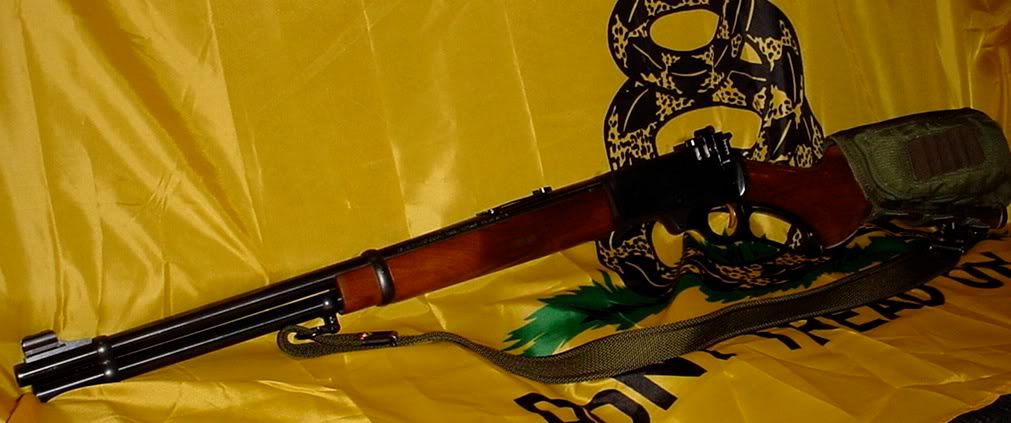
I finally got around to taking pictures of my 336 tonight. My rifle is a .30-30 made in 1978, before Marlin added the crossbolt safety. I bought it last Fall at a gun show in Valley Forge, for both hunting and SHTF.
It's fitted with a Williams FP336 rear sight and Firesight red front bead. To allow more light onto the front sight I drilled a hole in the top of the front sight hood (not shown). The sling is a British surplus L1A1 sling, which is basically a nylon version of the Lee-Enfield sling. Light, rugged, simple. It's attached using a set of Uncle Mike's QD swivels. I really wanted a butt cuff to carry extra ammo on the rifle. However, most cuffs don't work for lefties, the one I did find was $80. Instead, I picked up an Eagle Industries stock pack. Aside from 5 cartridge loops it has a zippered pouch which I put to good use.
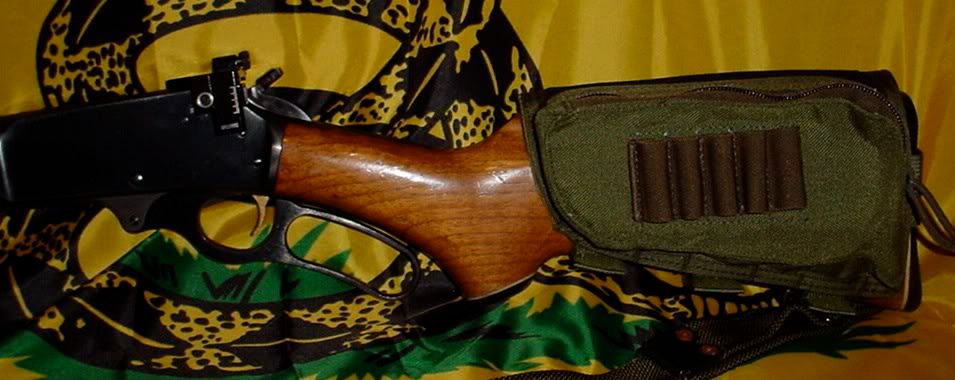

Inside a Ziploc bag inside the stock pack, I keep the following items to help me maintin the gun in the field and to start a fire, in case I get stuck out overnight:
The .30-30 is well suited for hunting medium and big game. Ammo is relatively cheap, easy to reload for, and it's available pretty much everywhere in the US. It's very easy to scrounge once fired brass around the deer season, as long as you're not in a shotgun-only state. The round itself is quite accurate. Recoil in the Marlins isn't bad (I find Winchester 94 carbines to kick too much for my comfort, however). Hornady's new LEVERevolution® ammo extends the effective range of the round beyond 200 yards.
In my humble opinion, a .30-30 lever action, whether a Marlin or Winchester, is a very useful addition to one's survival battery.
It's fitted with a Williams FP336 rear sight and Firesight red front bead. To allow more light onto the front sight I drilled a hole in the top of the front sight hood (not shown).
I finally got around to taking pictures of my 336 tonight. My rifle is a .30-30 made in 1978, before Marlin added the crossbolt safety. I bought it last Fall at a gun show in Valley Forge, for both hunting and SHTF.
It's fitted with a Williams FP336 rear sight and Firesight red front bead. To allow more light onto the front sight I drilled a hole in the top of the front sight hood (not shown). The sling is a British surplus L1A1 sling, which is basically a nylon version of the Lee-Enfield sling. Light, rugged, simple. It's attached using a set of Uncle Mike's QD swivels. I really wanted a butt cuff to carry extra ammo on the rifle. However, most cuffs don't work for lefties, the one I did find was $80. Instead, I picked up an Eagle Industries stock pack. Aside from 5 cartridge loops it has a zippered pouch which I put to good use.
Inside a Ziploc bag inside the stock pack, I keep the following items to help me maintin the gun in the field and to start a fire, in case I get stuck out overnight:
- Swedish fire steel
- 35mm film container stuffed with petroleum jelly-saturated cotton balls, for use as tinder.
- Some .270 - .35 caliber cleaning patches
- A couple of pipe cleaners
- A pull-through made from the orange pair stripped from a piece of CAT5e cabling
- A bottle of Ballistol (originally a RemOil bottle)
The .30-30 is well suited for hunting medium and big game. Ammo is relatively cheap, easy to reload for, and it's available pretty much everywhere in the US. It's very easy to scrounge once fired brass around the deer season, as long as you're not in a shotgun-only state. The round itself is quite accurate. Recoil in the Marlins isn't bad (I find Winchester 94 carbines to kick too much for my comfort, however). Hornady's new LEVERevolution® ammo extends the effective range of the round beyond 200 yards.
In my humble opinion, a .30-30 lever action, whether a Marlin or Winchester, is a very useful addition to one's survival battery.
Wednesday, July 18, 2007
Emergency Ration Taste Test
The August 2007 cover story in Popular Mechanics is about disaster preparedness. Meanwhile, PM has posted a comparison of three different emergency ration bars on their website, here.
{H/T InstaPundit.}
{H/T InstaPundit.}
Saturday, July 07, 2007
IOR Valdada 3x25mm CQB Scope Review
I formerly had a Hakko 4x21 scope mounted on my Colt AR-15A3 Tactical Carbine. I was considering replacing it with a Trijicon ACOG, in order to get a truly SHTF-worthy piece of glass. After doing a lot of online research and some comparison shopping, I got an IOR Valdada 3x25MM CQB scope instead.
I chose the IOR scope over the ACOG for two primary reasons: (1) cost and (2) the IOR's longer eye relief, which makes eye position much less critical.
IOR Valdada is a Romanian company which has been making scopes and binoculars since the 1930s. They use German-made Schott glass. The lenses are multi-coated to reduce glare, and the scope itself is sealed and filled with nitrogen. This should prevent any interior fogging. The optics are very clear with good resolution.
The IOR scope is compact but weighs in at one pound. It feels very solid. The adjustment clicks for windage and elevation are well-defined. The glass is very clear, definitely better than the Hakko's. The IOR CQB reticle is interesting and incorporates ranging features. The center dot subtends 2 minutes of angle (MOA, or about 2" at 100 yards), so it'll be more precise than the ~4 MOA dot in the Hakko.
The scope's reticle is etched on glass and can be illuminated using a battery powered built-in light, which uses CR2032 lithium coin cells. Without illum, the reticle is black. When illuminated, it's red, except for the horseshoe-shaped thingy in the reticle, which remains black. The illumination is not bright enough to be useful in full daylight. Even at its highest setting, the reticle just barely turns red. The illum works well at dusk and after, however.
The scope has a removable Picatinny rail sleeve around the objective lens side, intended for mounting tacticool stuff like a red dot sight, laser, or light. I have no plans to use the rails, but intend to leave the sleeve on as protection for the main body of the scope. The scope itself mounts to a Picatinny rail using a built-in mount secured by two captive nuts. This is not a quick-release design. The scope feels very rugged, but in the hopefully unlikely event that it goes TU, I'll need pliers or a wrench to remove it so I can use a back up iron sight (which I need to acquire).
After receiving the IOR scope, I bore sighted it at about 25 - 30 yards using a laser boresighter. (A toy house in my backyard stood in for a target.) Yesterday I got it out to the range and zeroed it on an SR-1 target at 100 yards. The laser bore sight got me on the paper but about 6" high and 6" left. It was short work to get POA to equal POI.
Adjustment of the scope is a bit different than most American hunting scopes. The windage and elevation knobs have hand adjustable turrets. Elevation goes from "0" up, while windage has a "0" with adjustments in both direction. If you reach the limits of adjustment, you loosen two Allen screws on the turret knobs and turn the turret independently of the outer ring that has the markings on it. Once you're zeroed, place the outer rings at the zero position and then retighten the Allen screws. An Allen key is provided with the scope for this purpose. The elevation wheel on my Hakko worked similarly.
IMO, the following areas could be improved:
1. Make the illumination brighter so it's useful in daylight.
2. Illuminate the horsesho part of the reticle, so that it can be used as a quick, coarse aiming point at "oh dammit" distances.
3. Replace the mounting nuts with thumb nuts similar to those seen on removable AR-15 carry handles. Or make a quick-release mount.
4. Improve the operator's manual. It's a couple of sheets that look like they came out of in inkjet printer. A better explanation of the scope's range finding reticle would be helpful.
Overall, I am pleased with my choice. The IOR Valdada 3x35mm CQB scope is rugged, has clear optics, a good reticle, and its compact size matches my carbine well.
Technical specs for the IOR Valdada 3x25mm CQB Scope:
Magnification 3x
Objective diameter 25mm
Field of view at 100 yards 31 feet
Exit pupil diameter 8.25mm
Eye relief 3.50 inches
Diopter adjustment -4 to +4 dpt.
Click adjustment 1/4 min.
Tube diameter 30mm
Length 5.65 inches
Weight 16 oz
I chose the IOR scope over the ACOG for two primary reasons: (1) cost and (2) the IOR's longer eye relief, which makes eye position much less critical.
IOR Valdada is a Romanian company which has been making scopes and binoculars since the 1930s. They use German-made Schott glass. The lenses are multi-coated to reduce glare, and the scope itself is sealed and filled with nitrogen. This should prevent any interior fogging. The optics are very clear with good resolution.
The IOR scope is compact but weighs in at one pound. It feels very solid. The adjustment clicks for windage and elevation are well-defined. The glass is very clear, definitely better than the Hakko's. The IOR CQB reticle is interesting and incorporates ranging features. The center dot subtends 2 minutes of angle (MOA, or about 2" at 100 yards), so it'll be more precise than the ~4 MOA dot in the Hakko.
The scope's reticle is etched on glass and can be illuminated using a battery powered built-in light, which uses CR2032 lithium coin cells. Without illum, the reticle is black. When illuminated, it's red, except for the horseshoe-shaped thingy in the reticle, which remains black. The illumination is not bright enough to be useful in full daylight. Even at its highest setting, the reticle just barely turns red. The illum works well at dusk and after, however.
The scope has a removable Picatinny rail sleeve around the objective lens side, intended for mounting tacticool stuff like a red dot sight, laser, or light. I have no plans to use the rails, but intend to leave the sleeve on as protection for the main body of the scope. The scope itself mounts to a Picatinny rail using a built-in mount secured by two captive nuts. This is not a quick-release design. The scope feels very rugged, but in the hopefully unlikely event that it goes TU, I'll need pliers or a wrench to remove it so I can use a back up iron sight (which I need to acquire).
After receiving the IOR scope, I bore sighted it at about 25 - 30 yards using a laser boresighter. (A toy house in my backyard stood in for a target.) Yesterday I got it out to the range and zeroed it on an SR-1 target at 100 yards. The laser bore sight got me on the paper but about 6" high and 6" left. It was short work to get POA to equal POI.
Adjustment of the scope is a bit different than most American hunting scopes. The windage and elevation knobs have hand adjustable turrets. Elevation goes from "0" up, while windage has a "0" with adjustments in both direction. If you reach the limits of adjustment, you loosen two Allen screws on the turret knobs and turn the turret independently of the outer ring that has the markings on it. Once you're zeroed, place the outer rings at the zero position and then retighten the Allen screws. An Allen key is provided with the scope for this purpose. The elevation wheel on my Hakko worked similarly.
IMO, the following areas could be improved:
1. Make the illumination brighter so it's useful in daylight.
2. Illuminate the horsesho part of the reticle, so that it can be used as a quick, coarse aiming point at "oh dammit" distances.
3. Replace the mounting nuts with thumb nuts similar to those seen on removable AR-15 carry handles. Or make a quick-release mount.
4. Improve the operator's manual. It's a couple of sheets that look like they came out of in inkjet printer. A better explanation of the scope's range finding reticle would be helpful.
Overall, I am pleased with my choice. The IOR Valdada 3x35mm CQB scope is rugged, has clear optics, a good reticle, and its compact size matches my carbine well.
Technical specs for the IOR Valdada 3x25mm CQB Scope:
Magnification 3x
Objective diameter 25mm
Field of view at 100 yards 31 feet
Exit pupil diameter 8.25mm
Eye relief 3.50 inches
Diopter adjustment -4 to +4 dpt.
Click adjustment 1/4 min.
Tube diameter 30mm
Length 5.65 inches
Weight 16 oz
Sunday, July 01, 2007
REI is selling Mountain House freeze dried food at 20% off in conjunction with their Fourth of July sale. I haven't had any freeze dried food in many years and wanted to try it out as potential food for my emergency stash. I live about 5 minutes from the Conshohocken, PA REI, so today I went over and bought three of their single-serving Pro-Pak meals. The Pro-Paks are vacuum-packed so that they don't take up too much room in a pack. Between the freeze drying and vacuum packing, they should last years.
I bought one each of the beef stroganoff, spaghetti with meat sauce, and scrambled eggs with ham and green and red peppers. I tried the beef stroganoff for lunch. To prepare it, you add 1.5 cups of boiling water to the Pro-Pak pouch, stir well, seal it, let sit for for about 8 - 9 minutes. You can then open it up, stir again, and eat it right from the pouch.
It was quite good. Surprisingly good for food that just got reconstituted. I am impressed. The 16 oz. size was perfect for me, enough to be filling but I'm not overstuffed. This particular meal has a total of 520 calories, 190 of which are from fat. It also has 1920mg of sodium, so people on special diets need to take note.
I see a few advantages of freeze dried meals:
1. LONG shelf life. I've seen some advertised with a 30 year shelf life. The beef stroganoff's pouch is stamped "best used by December 2013." AFAIK it'll be safe beyond that but the taste may deteriorate.
2. Lighter in weight than food which hasn't been dehydrated, e.g., cans or MREs.
3. Easy to prepare. Just add boiling water to the pouch, and wait about 10 minutes.
4. The pouch that it's packed in can be used to reconstitute and serve the food, then discarded. No need to wash dishes.
There are some cons:
1. High sodium content.
2. You have to provide water to reconstitute them.
3. Said water needs to be hot, preferably boiling, for the food to reconstitute in a reasonable amount of time. This means you need something to boil the water in, and something to heat it.
I am planning to pick up some more while it's still on sale.
I bought one each of the beef stroganoff, spaghetti with meat sauce, and scrambled eggs with ham and green and red peppers. I tried the beef stroganoff for lunch. To prepare it, you add 1.5 cups of boiling water to the Pro-Pak pouch, stir well, seal it, let sit for for about 8 - 9 minutes. You can then open it up, stir again, and eat it right from the pouch.
It was quite good. Surprisingly good for food that just got reconstituted. I am impressed. The 16 oz. size was perfect for me, enough to be filling but I'm not overstuffed. This particular meal has a total of 520 calories, 190 of which are from fat. It also has 1920mg of sodium, so people on special diets need to take note.
I see a few advantages of freeze dried meals:
1. LONG shelf life. I've seen some advertised with a 30 year shelf life. The beef stroganoff's pouch is stamped "best used by December 2013." AFAIK it'll be safe beyond that but the taste may deteriorate.
2. Lighter in weight than food which hasn't been dehydrated, e.g., cans or MREs.
3. Easy to prepare. Just add boiling water to the pouch, and wait about 10 minutes.
4. The pouch that it's packed in can be used to reconstitute and serve the food, then discarded. No need to wash dishes.
There are some cons:
1. High sodium content.
2. You have to provide water to reconstitute them.
3. Said water needs to be hot, preferably boiling, for the food to reconstitute in a reasonable amount of time. This means you need something to boil the water in, and something to heat it.
I am planning to pick up some more while it's still on sale.
Wednesday, June 20, 2007
Physical Fitness for Preparedness
One of the more important things for emergency preparedness is physical fitness. By this I don't mean you need to be able to run a 10K or bench press 200 pounds. However, you should be in decent enough shape so that if necessary you can walk at least 5 miles, or perform damage control to your home after a storm.
This is an area in which my preps have been lagging.
The men on my father's side of the family tend to develop guts, and I inherited the trait. In fact, it's been a bit of a joke topic among my friends. Compounding my natural tendency to put on weight around my gut was a bout of poison ivy I had last year, for which I had to take steroids to reduce the inflamation to barely tolerable levels. A side effect of the steroids was that I put on about 13 pounds of pure flab in the space of two weeks, and it never went away.
This week I decided to do something about it. On Monday I walked two laps around my neighborhood (each lap is a mile). I missed last night due to having to stay home with my kids and then a thunderstorm, but I got out and did another two miles tonight. Brisk walking is a good low impact exercise that gets your heart rate up. My wife started it a month or so ago and has already lost about 10 pounds, doing one lap each day.
As for dieting, every single person I've seen who diets has eventually regained any weight lost, and then some. So, I don't plan to diet, but I will try to cut out drinking any soda. I'm hoping that if I can keep this up that by the end of the summer I'll at least lose the 13 extra pounds I packed on last year.
This is an area in which my preps have been lagging.
The men on my father's side of the family tend to develop guts, and I inherited the trait. In fact, it's been a bit of a joke topic among my friends. Compounding my natural tendency to put on weight around my gut was a bout of poison ivy I had last year, for which I had to take steroids to reduce the inflamation to barely tolerable levels. A side effect of the steroids was that I put on about 13 pounds of pure flab in the space of two weeks, and it never went away.
This week I decided to do something about it. On Monday I walked two laps around my neighborhood (each lap is a mile). I missed last night due to having to stay home with my kids and then a thunderstorm, but I got out and did another two miles tonight. Brisk walking is a good low impact exercise that gets your heart rate up. My wife started it a month or so ago and has already lost about 10 pounds, doing one lap each day.
As for dieting, every single person I've seen who diets has eventually regained any weight lost, and then some. So, I don't plan to diet, but I will try to cut out drinking any soda. I'm hoping that if I can keep this up that by the end of the summer I'll at least lose the 13 extra pounds I packed on last year.
Wednesday, June 06, 2007
DIY Portable Power Pack
I found this article today on eHam.net: Time For a New Portable Power Pack? It's a rather nifty homebrewed portable battery system for powering radios and other electronics.
Saturday, June 02, 2007
Swisstool Follow Up
I took the Swisstool RS out back and tested out the knife and saw blades. Both cut well. I managed to slice some skin off the tip of my right index finger while cleaning the knife blade and didn't notice it until I saw something funny on the blade. It's sharp!
I posted my review to a few places aside from this blog and got some good feedback. Over on Arfcom's Survival Forum, "nightfighter4d" posted from Iraq:
And on the Yahoogroups Backwoodsman list, Chuck M. noted:
I posted my review to a few places aside from this blog and got some good feedback. Over on Arfcom's Survival Forum, "nightfighter4d" posted from Iraq:
I've been saying once you get a Swiss tool the Gerber / Leatherman debate becomes moot. I love my Swiss Tool. I will once again say that the Swiss Tool is BOMB proof. I know from experience. Many happy years of use.
You forgot two tools Dave
The Pry Bar.
With the pliers out I hve used them to pry open more than one ammo crate.
The hammer.
I have driven nails with it closed up. As long as you use the side of the handle you are fine. A lil hard to control.
Once Again BOMB proof
And on the Yahoogroups Backwoodsman list, Chuck M. noted:
I can concur with everything Dave says here and more. I bought mine almost 5 or 6 years ago and it has been great. I paid under $40 back then, but at 60 or 70, it is still a deal. I actually bought 2, the second one went to a friend just before he traveled to Afghanistan as a contractor. This guy is a retired SEAL. He appreciated the gift somewhat when I gave it to him, but he really fell in love when they hit the ground in A-stan. You see, they had pallets filled with crates of equipment, weapons and ammo and stuff, but no one, anywhere, had a tool to open things up. They were alone on a deserted dirt runway in the middle of nowhere with no weapons, tools, ammo, etc. Then he remembered my gift n his belt and used it to get at their stuff. Boy, did I get a nice "thank you!" the next time we were able to communicate.
It still gets used regularly as he has pretty much been "over there" (Afghanistan and Iraq) constantly for 4 or 5 years now, God bless him...
Friday, June 01, 2007
Victorinox Swisstool RS Multitool
I just got a Victorinox Swisstool RS multitool.
I've had a couple of Gerber Multipliers that have served me well but kept reading how good the Swisstools are, so I ordered one from Amazon last week. My initial impression is, "WOW!" The Swisstool is really well made and finished. It feels considerably more solid than the Gerbers I have, or the Leatherman tools I've handled. I shouldn't be too surprised, since I have four other Victorinox Swiss Army Knives: a Cybertool 41, and three Pioneers, one of which I've gone back to my everyday carry knife, having bought it in the early 1980s. (I keep one Pioneer in each of our vehicles for emergency use.)
The Swisstool RS includes the following tools:
* Pliers
* Screwdriver (2mm)
* Screwdriver (3mm)
* Wire cutter (for wire up to a hardness of 40 hrc)
* Screwdriver (5mm)
* Bottle opener
* Screwdriver (7.5 mm)
* Large blade
* Scissors
* Belt cutter
* Wood saw
* Reamer/punch
* Phillips screwdriver
* Chisel/scraper
* Strong crate opener
* Wire bender
* Wire stripper
* Wire scraper
* Wire crimper
* Can opener
* Ruler (9 inches)
* Ruler (230mm)
* Hard wire cutter
Except for the pliers, the individual tools can be accessed without opening the tool. Each tool locks in place, so you don't have to be concerned with them closing on your fingers. The handle is contoured so that it doesn't dig into your hand when you squeeze down on the pliers. The knife blade, belt cutter, and reamer are very sharp. The seat belt cutter is a serrated, curved blade with a round point. The cutting edge is on the inside of the curve. I could this being useful on boats when you need to cut something but don't want to risk using a pointy knife. The scissors are slightly larger than those on my Cybertool 41, with which I've cut a fair amount of CAT5. The scissors are nice and sharp.
A well-constructed black nylon belt sheath with a snap closure was included. The sheath is designed to stay open so that you can easily re-sheath the multitool with one hand.
So far, I've used the bottle opener, to open a bottle of Yuengling Lager. Works great. :-) I also tested the scissors on some heavy corrugated cardboard and they worked well.
The Swisstool comes with a lifetime guaranty from Victorinox against defects in materials and workmanship.
MSRP is $100 but many places online sell it for much less. I paid about two-thirds of that at Amazon.
If you're in the market for a good multitool, the Swisstools from Victorinox are definitely worth looking at.
I've had a couple of Gerber Multipliers that have served me well but kept reading how good the Swisstools are, so I ordered one from Amazon last week. My initial impression is, "WOW!" The Swisstool is really well made and finished. It feels considerably more solid than the Gerbers I have, or the Leatherman tools I've handled. I shouldn't be too surprised, since I have four other Victorinox Swiss Army Knives: a Cybertool 41, and three Pioneers, one of which I've gone back to my everyday carry knife, having bought it in the early 1980s. (I keep one Pioneer in each of our vehicles for emergency use.)
The Swisstool RS includes the following tools:
* Pliers
* Screwdriver (2mm)
* Screwdriver (3mm)
* Wire cutter (for wire up to a hardness of 40 hrc)
* Screwdriver (5mm)
* Bottle opener
* Screwdriver (7.5 mm)
* Large blade
* Scissors
* Belt cutter
* Wood saw
* Reamer/punch
* Phillips screwdriver
* Chisel/scraper
* Strong crate opener
* Wire bender
* Wire stripper
* Wire scraper
* Wire crimper
* Can opener
* Ruler (9 inches)
* Ruler (230mm)
* Hard wire cutter
Except for the pliers, the individual tools can be accessed without opening the tool. Each tool locks in place, so you don't have to be concerned with them closing on your fingers. The handle is contoured so that it doesn't dig into your hand when you squeeze down on the pliers. The knife blade, belt cutter, and reamer are very sharp. The seat belt cutter is a serrated, curved blade with a round point. The cutting edge is on the inside of the curve. I could this being useful on boats when you need to cut something but don't want to risk using a pointy knife. The scissors are slightly larger than those on my Cybertool 41, with which I've cut a fair amount of CAT5. The scissors are nice and sharp.
A well-constructed black nylon belt sheath with a snap closure was included. The sheath is designed to stay open so that you can easily re-sheath the multitool with one hand.
So far, I've used the bottle opener, to open a bottle of Yuengling Lager. Works great. :-) I also tested the scissors on some heavy corrugated cardboard and they worked well.
The Swisstool comes with a lifetime guaranty from Victorinox against defects in materials and workmanship.
MSRP is $100 but many places online sell it for much less. I paid about two-thirds of that at Amazon.
If you're in the market for a good multitool, the Swisstools from Victorinox are definitely worth looking at.
Sunday, May 20, 2007
REI Basecamp 6 Tent
A couple weeks ago while REI was running a sale, I bought one of their Basecamp 6 tents for family camping and bug out use. It's a six person dome with aluminum, shock corded poles, and a separate rain fly. (My family is four people but I wanted a bit more space than a 4 person tent.) It's self-supporting but has loops to stake it down if it's windy. The floor is 10'5" x 8'4". This afternoon I finally had a confluence of good weather and free time, so I got to set it up in the backyard.
Here's how it looks without the rain fly:

And here it is with the fly:
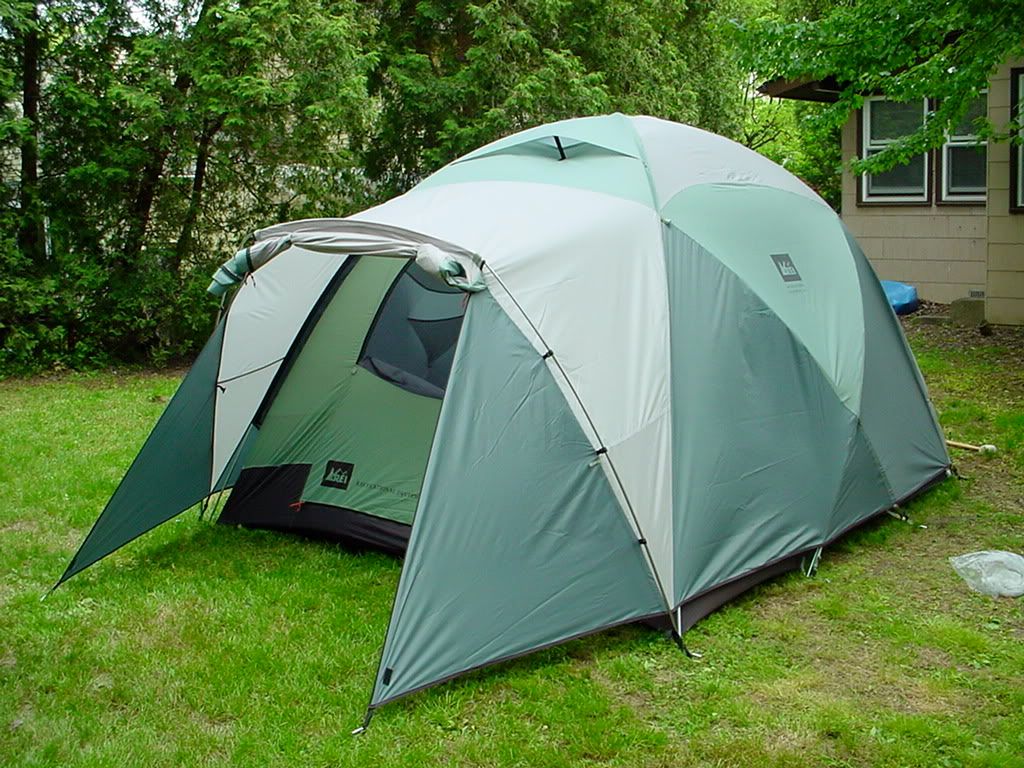
Closeup of the vestibule, which'll be handy for gear storage:
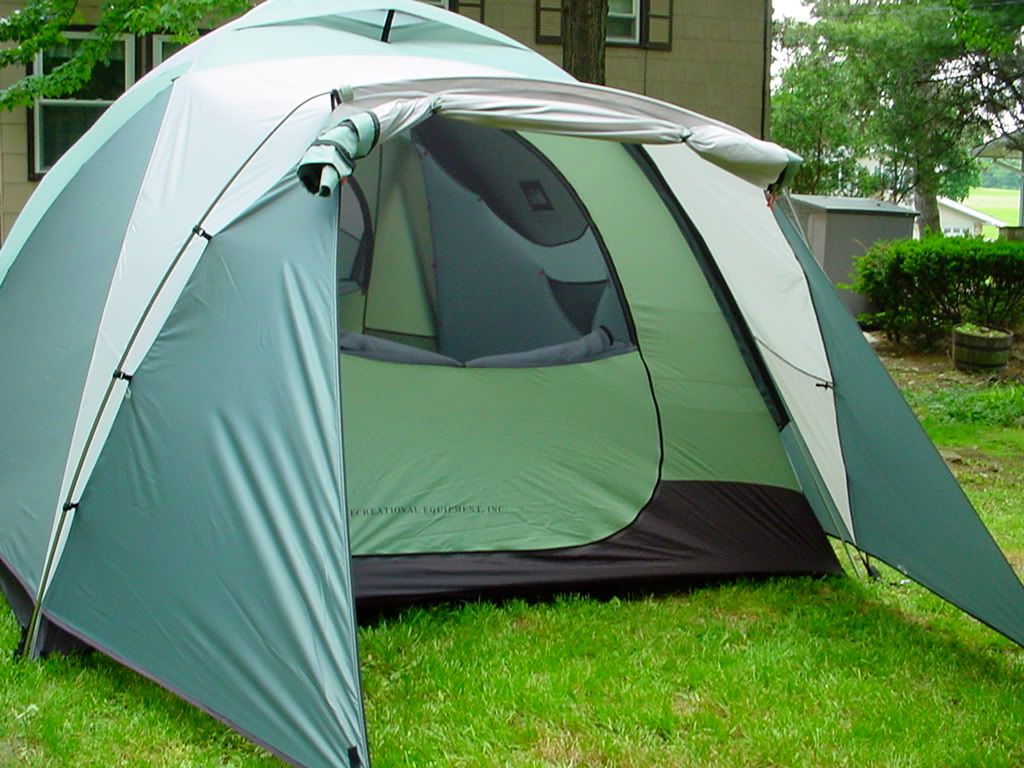
In the last two pictures, you can see one of the two vents in the fly. These are held open with Velcro-encased plastic rods, that you access through zippers in the roof of the tent. Unless rain blows into them they should be weather-resistant. They can be closed if you really need to batten down the hatches.
I have several more pictures of the tent here.
Inside, there are several loops and mesh pouches sewn to the tent wall, along with a mesh gear loft up top, for stowing small items. If you don't use the loft there's a sturdy loop sewn to the center of the roof, from which you can hang a lantern. I am very pleased with both the workmanship and design of the tent, and I'm really looking forward to taking it out into the woods this summer.
Here's how it looks without the rain fly:
And here it is with the fly:
Closeup of the vestibule, which'll be handy for gear storage:
In the last two pictures, you can see one of the two vents in the fly. These are held open with Velcro-encased plastic rods, that you access through zippers in the roof of the tent. Unless rain blows into them they should be weather-resistant. They can be closed if you really need to batten down the hatches.
I have several more pictures of the tent here.
Inside, there are several loops and mesh pouches sewn to the tent wall, along with a mesh gear loft up top, for stowing small items. If you don't use the loft there's a sturdy loop sewn to the center of the roof, from which you can hang a lantern. I am very pleased with both the workmanship and design of the tent, and I'm really looking forward to taking it out into the woods this summer.
Saturday, May 12, 2007
Quicksilver Radio PanelRelief(TM)
Hmm, haven't posted here in awhile.
Last night I installed a Quicksilver Radio PanelRelief(TM) bulkhead in my ham shack/office/laundry room (can I multi-task or what?!). The PanelRelief is an adjustable two-piece Lexan panel that sits in a window, and has two M-M connectors. The one I ordered has two SO-239 connectors. This allows me to run my antenna cable into my shack through the window without having it open to the elements.
Along with the PanelRelief, I got a 3-foot antenna patch cable to connect the inside connector to my FT-7800R, a roll of Coaxseal, and a single PowerPole to dual PowerPole splitter cable.
I tested the new setup by getting on last night's MARC net. Everything sounded good to me and apparently my signal was getting out fine.
Around 1700 tonight I heard thunder so I ran into the office and disconnected the patch cord from the PanelRelief. The easy ability to do this was another reason I got it.
Last night I installed a Quicksilver Radio PanelRelief(TM) bulkhead in my ham shack/office/laundry room (can I multi-task or what?!). The PanelRelief is an adjustable two-piece Lexan panel that sits in a window, and has two M-M connectors. The one I ordered has two SO-239 connectors. This allows me to run my antenna cable into my shack through the window without having it open to the elements.
Along with the PanelRelief, I got a 3-foot antenna patch cable to connect the inside connector to my FT-7800R, a roll of Coaxseal, and a single PowerPole to dual PowerPole splitter cable.
I tested the new setup by getting on last night's MARC net. Everything sounded good to me and apparently my signal was getting out fine.
Around 1700 tonight I heard thunder so I ran into the office and disconnected the patch cord from the PanelRelief. The easy ability to do this was another reason I got it.
Wednesday, March 28, 2007
How to Practice Law in a Barn
New Orleans attorney Jack Deverin wrote an interesting article in December that I just ran across. "How to Practice Law in a Barn" describes how he continued his law practice in the aftermath of Hurricane Katrina. In it, he provides valuable information on business continuity in the the wake of disaster. Check it out.
Friday, March 02, 2007
Henley's Twentieth Century Book of Recipes, Formulas and Processes
I found this book today via Jerry Pournelle's site.
It's the sort of reference you'd want around after a TEOTWAWKI event. Or just to learn how to mix up stuff in the garage sure to piss off the Feds. ;-)
The PDF version is a facsimile of the c.1914 original. It's rather large at over 800 pages and 116 MB but whoever created the PDF also OCRed the file, so it's searchable. If you have a slower connection or an older computer you'll probably be better off with the .txt version, which is only 3.5MB.
I may print it out, two pages to a sheet, and stick it in a binder.
It's the sort of reference you'd want around after a TEOTWAWKI event. Or just to learn how to mix up stuff in the garage sure to piss off the Feds. ;-)
The PDF version is a facsimile of the c.1914 original. It's rather large at over 800 pages and 116 MB but whoever created the PDF also OCRed the file, so it's searchable. If you have a slower connection or an older computer you'll probably be better off with the .txt version, which is only 3.5MB.
I may print it out, two pages to a sheet, and stick it in a binder.
Saturday, February 17, 2007
Post-Storm Lessons Learned
It's been too long since I posted anything here.
This past week we got a major snow and ice storm in Pennsylvania. My area didn't get too much snow, but we did get a few inches of sleet which shortly compacted into an ice crust. Thankfully, I was able to work from home so didn't have to try venturing out into it, even though my employer was open.
When it came time to clear my sidewalks and driveway I ran into trouble. My snowblower had been sitting since last year and both tires were flat, and unseated from the rims. I wasn't able to get them back on myself. (I know about the starting fluid + a match trick, but didn't want to blow myself up.) Luckily, my neighbor bailed me out and cleared off my sidewalk with his snowblower. I could have shoveled it, but this stuff was heavy and the whole reason I bought a snowblower was to save my back.
This morning I took my snowblower out of the shed and took the wheels off, then brought them up to the service station at the end of my block, where the mechanic was able to get the tires seated on the rims and inflated. I wasn't the first person to do so since Wednesday. Now it's all back together with a block of wood underneath the center, keeping the wheels off the ground while it's in storage. Annoying but now I know better.
Hopefully more people will take away some lessons from the I-78 SNAFU which makes my little inconvenience a trifling matter. As you're probably aware, many motorists got stranded on I-78 in Berks County, many of whom had to sit in a 50 mile traffic jam through a blizzard. PennDOT could've done better, but if you're traveling in winter it's foolish to go unprepared for getting stuck, even if you plan to take only major highways. At a minimum, dress appropriately, make sure your car has water and food for at least 24 hours, a candle lantern and matches or a lighter*, blankets or sleeping bags for each person, and a charger for your cell phone. A CB radio is a very handy thing to have when on the highway.
* Aside from light, a candle can warm the interior of a stranded vehicle. Many of the folks stuck ran their cars for heat until they were out of gas.
This past week we got a major snow and ice storm in Pennsylvania. My area didn't get too much snow, but we did get a few inches of sleet which shortly compacted into an ice crust. Thankfully, I was able to work from home so didn't have to try venturing out into it, even though my employer was open.
When it came time to clear my sidewalks and driveway I ran into trouble. My snowblower had been sitting since last year and both tires were flat, and unseated from the rims. I wasn't able to get them back on myself. (I know about the starting fluid + a match trick, but didn't want to blow myself up.) Luckily, my neighbor bailed me out and cleared off my sidewalk with his snowblower. I could have shoveled it, but this stuff was heavy and the whole reason I bought a snowblower was to save my back.
This morning I took my snowblower out of the shed and took the wheels off, then brought them up to the service station at the end of my block, where the mechanic was able to get the tires seated on the rims and inflated. I wasn't the first person to do so since Wednesday. Now it's all back together with a block of wood underneath the center, keeping the wheels off the ground while it's in storage. Annoying but now I know better.
Hopefully more people will take away some lessons from the I-78 SNAFU which makes my little inconvenience a trifling matter. As you're probably aware, many motorists got stranded on I-78 in Berks County, many of whom had to sit in a 50 mile traffic jam through a blizzard. PennDOT could've done better, but if you're traveling in winter it's foolish to go unprepared for getting stuck, even if you plan to take only major highways. At a minimum, dress appropriately, make sure your car has water and food for at least 24 hours, a candle lantern and matches or a lighter*, blankets or sleeping bags for each person, and a charger for your cell phone. A CB radio is a very handy thing to have when on the highway.
* Aside from light, a candle can warm the interior of a stranded vehicle. Many of the folks stuck ran their cars for heat until they were out of gas.
Saturday, January 13, 2007
DIY Soda Can Lantern
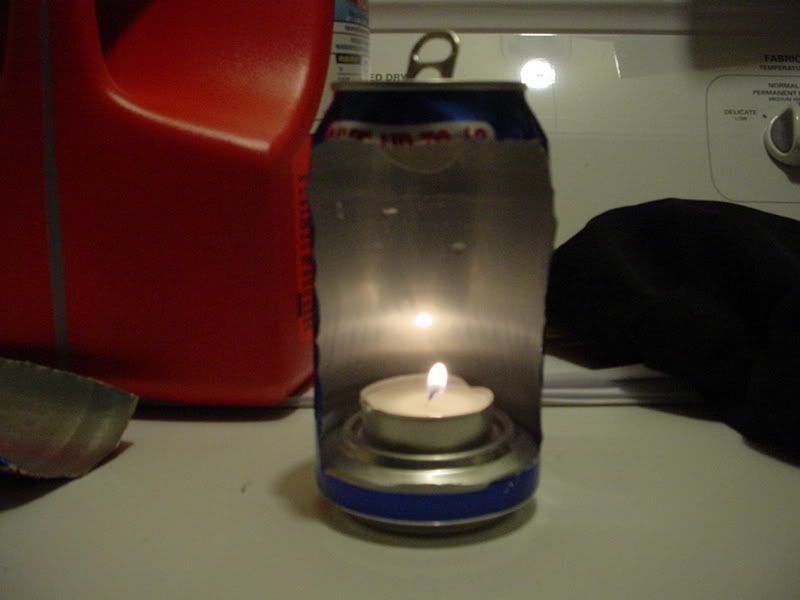
I got this idea from the DIY Vietnam Lantern post in the Arfcom Survival Forum. It cost nothing and the only tool I used was the blade on my Swiss Army knife.
You need two soda cans. Cut away most of one side of the first can. Next, cut the bottom off of a second can about 3/8" above where the wall and the base meet. Put the cut off bottom inside the first can and place a tea light in the center recess.
And a second shot with the lights out:

The silver inside of the soda can maximizes the limited amount of light you get from a candle or tea light and shields it from drafts. Note that the can does get hot so be careful if you pick it up. I wouldn't walk around with this, since if you trip you'll be dropping a lit candle and could start a fire. But for emergency use in a power outage, or placed on the dashboard of a snowbound car, it would be handy. (Make sure you crack a window if you're using it in a car.)
You need two soda cans. Cut away most of one side of the first can. Next, cut the bottom off of a second can about 3/8" above where the wall and the base meet. Put the cut off bottom inside the first can and place a tea light in the center recess.
And a second shot with the lights out:
The silver inside of the soda can maximizes the limited amount of light you get from a candle or tea light and shields it from drafts. Note that the can does get hot so be careful if you pick it up. I wouldn't walk around with this, since if you trip you'll be dropping a lit candle and could start a fire. But for emergency use in a power outage, or placed on the dashboard of a snowbound car, it would be handy. (Make sure you crack a window if you're using it in a car.)
Sunday, January 07, 2007
Will your phone work with the power out?
Will your phone work with the power out?
Old fashioned line-powered phones don't need an external power source. They get their operating power right from the phone line.
However, most of us have cordless phones with a base station and one or more handsets. Many of us use VOIP phones, such as Vonage, which use our Internet connection. No line power there.
The easiest way to ensure you have a working telephone during a power outage, if your phones are not line powered but you still have regular phone service, is to keep a line powered phone around. You can pick them up cheap at Lowe's or Home Despot for around $10 each. If you have VOIP service which depends on an Internet connection*, then you need a battery backup, AKA uninterruptible power supply.
You can buy UPSes meant for computers and networking gear at places like Staples, Office Depot, Microcenter, or CompUSA. Well known, reputable brands include Belkin, American Power Conversion (APC), and Tripplite. Prices will range from a low of around $30 to enough to melt your Master Card.
UPS capacity is measured in Volt Amps (VA). The more the VA, the longer you'll have power available. How long it'll last depends on what you have connected to the UPS. E.g., if you keep surfing the web on battery backup it's going to kill your battery sooner than if you have only your Vonage router and cable modem connected.
Note that some equipment will continue to draw power even if the power switch is off. E.g., most recent PCs have a power switch on the front of the case and a second one on the power supply in back. If you leave the PC connected to the UPS, it'll continue to draw a little bit of power unless you unplug it or turn off the switch on the power supply in the back of the case. I also recommend against plugging printers and scanners into a UPS because of the potential for draining the power, especially if the printer/scanner is on and the power goes offline when you're not home. Plug printers and scanners into surge protectors, which are plugged into mains power.
If a power outage lasts more than a day or two it's likely that the UPS will run out of juice. But if most power outages you experience are short term, a UPS is a worthwhile investment to keep your primary means of communication open.
* ISPs have their equipment on massive battery backups and/or backup generators, so they often stay online during power outages. ASSuming that the cables haven't been knocked down, you can usually get online if you have backup power.
Old fashioned line-powered phones don't need an external power source. They get their operating power right from the phone line.
However, most of us have cordless phones with a base station and one or more handsets. Many of us use VOIP phones, such as Vonage, which use our Internet connection. No line power there.
The easiest way to ensure you have a working telephone during a power outage, if your phones are not line powered but you still have regular phone service, is to keep a line powered phone around. You can pick them up cheap at Lowe's or Home Despot for around $10 each. If you have VOIP service which depends on an Internet connection*, then you need a battery backup, AKA uninterruptible power supply.
You can buy UPSes meant for computers and networking gear at places like Staples, Office Depot, Microcenter, or CompUSA. Well known, reputable brands include Belkin, American Power Conversion (APC), and Tripplite. Prices will range from a low of around $30 to enough to melt your Master Card.
UPS capacity is measured in Volt Amps (VA). The more the VA, the longer you'll have power available. How long it'll last depends on what you have connected to the UPS. E.g., if you keep surfing the web on battery backup it's going to kill your battery sooner than if you have only your Vonage router and cable modem connected.
Note that some equipment will continue to draw power even if the power switch is off. E.g., most recent PCs have a power switch on the front of the case and a second one on the power supply in back. If you leave the PC connected to the UPS, it'll continue to draw a little bit of power unless you unplug it or turn off the switch on the power supply in the back of the case. I also recommend against plugging printers and scanners into a UPS because of the potential for draining the power, especially if the printer/scanner is on and the power goes offline when you're not home. Plug printers and scanners into surge protectors, which are plugged into mains power.
If a power outage lasts more than a day or two it's likely that the UPS will run out of juice. But if most power outages you experience are short term, a UPS is a worthwhile investment to keep your primary means of communication open.
* ISPs have their equipment on massive battery backups and/or backup generators, so they often stay online during power outages. ASSuming that the cables haven't been knocked down, you can usually get online if you have backup power.
Monday, January 01, 2007
Thoughts on Selecting .22 Rimfire Ammunition
Most preparedness-minded people will have a least one .22 around. They are excellent for small game hunting, target practice, plinking, training new shooters, vermin control, and can be pressed into use for defense. However, many people fail to properly select the best ammunition for their .22s, focusing instead on price alone. In this post I'll discuss some criteria for selecting the best .22 ammo, focusing on .22 Long Rifle.
Rifles and pistols chambered for .22 Long Rifle can safely chamber and fire the following cartridges:
There are "hyper velocity" .22 LRs like CCI Stingers and Velocitors, and Remington Yellow Jackets and Vipers. Conversely, there are standard velocity rounds intended for hunting, e.g., CCI Subsonic HPs and Aguila Sniper Subsonics. The latter is a .22 LR length round, but loaded with a heavy 60 grain bullet in a .22 Short case.
Most .22 LR semiautos will function only with Long Rifles. The other rounds won't have enough power to function the action. The Remington Model 572 is a notable exception, being designed to function with Shorts, Longs, or Long Rifles. Sometimes, manually operated repeaters won't function with anything other than LRs either. However, they'll work as a single shot if you load the round directly into the chamber.
Standard velocity rounds, especially hollowpoints or solids which have been flatnosed, work well for small game hunting with good shot placement. They are quieter than high speed loads and often are more accurate.
For controlling vermin larger than rats, high speed or hyper velocity hollowpoints work better than standard velocity loads, except for the Aguila Sniper Subsonics. .22 LR can be used on varmints up to the size of woodchucks and racoons, but shot placement is key. I've seen a rabid raccoon that weighed about 15 lbs absorb over a half dozen high speed hollowpoints PLUS 5 standard velocity solids without expiring. These were all hits in the chest cavity from no more than 10 - 15 yards. A shot through the brain was required to finally kill it.
Small vermin such as rats can be taken care of with standard velocity loads, .22 Shorts, or even CB Caps. I have a couple of boxes of CCI .22 CB Longs that I keep around in case this is necessary. Fired from a rifle, they are about as noisy as an airgun. In other words, pretty darn quiet.
While it's better than nothing, a .22 is not a good choice for defense against people. It simply doesn't have enough bullet mass to reliably stop an aggressor. See my comments about the rabid raccoon above. The light weight, relatively low velocity bullets don't pack enough punch to reliabily penetrate to an attacker's vitals and cause enough damage to force him to stop. That said, high velocity solids would be my choice if I needed to use a .22 for defense; the specific load I'd want would be CCI Mini Mag solids for both its relatively good penetration and CCI's high quality. The only time I'd recommend a .22 for a defensive gun would be for someone who can't handle anything bigger. But, if push came to shove in a worst case scenario, and a child needed to help defend the homestead, then something like a 10/22 with a full load of Mini Mags beats a sharp stick.
The best accuracy will almost always be obtained with some kind of .22 LR ammo. When fired in a LR chamber, bullets from .22 Shorts have a long jump from the case to the rifling, which hurts accuracy. The rounds that a given gun will shoot the most accurately can only be determined by trying a variety of ammo. I recommend buying a 50 round box or two of several kinds of ammo and shooting them at a paper target from a bench, to see what the gun likes best. Shoot at least a couple of targets, at least one of them at 50 yards, to see how individual loads work at a distance.
Shooting for accuracy out to 50 yards is especially important with the Aguila Sniper Subsonics. The heavy 60 grain bullets pack a wallop but are often unstable in .22 rifles with the standard 1-in-16" rifling twist. Since they are somewhat expensive, it's a good idea to test a box to see if they'll shoot acceptably in your gun before acquiring a substantial quantity.
In my experience, the most uniformly accurate and high quality .22 LR ammo (other than specialty target loads like Eley Tenex) is made by CCI. I used to favor Winchester PowerPoints, but had several duds in one brick. I've never had a CCI .22 fail to go off. CCI Mini Mags and Subsonic Hollowpoints function well and shoot accurately in all of the .22s in which I've tried them, including a Ruger 10/22. Savage Mark IIGL, S&W Model 18, Ruger Single Six, and a Winchester 9422.
I recommend storing rimfire ammo in an airtight ammo can, either a GI surplus can or something like an MTM Sportsman's Dry Box. Rimfire ammo is not as well sealed against moisture penetration as centerfire ammo, and if the ammo gets wet or is exposed to humidity for a long time it may go bad.
Hopefully this post has given you some food for thought regarding .22 rimfire ammunition selection. Please share your insights in the comments.
Rifles and pistols chambered for .22 Long Rifle can safely chamber and fire the following cartridges:
- .22 BB Cap (mostly unavailable)
- .22 CB Cap (available in both Short and Long cases)
- .22 Short
- .22 Long (No longer very common)
- .22 Long Rifle in both standard velocity (subsonic) and high-speed.
- .22 LR Shot (I haven't tried these so won't comment further.)
There are "hyper velocity" .22 LRs like CCI Stingers and Velocitors, and Remington Yellow Jackets and Vipers. Conversely, there are standard velocity rounds intended for hunting, e.g., CCI Subsonic HPs and Aguila Sniper Subsonics. The latter is a .22 LR length round, but loaded with a heavy 60 grain bullet in a .22 Short case.
Most .22 LR semiautos will function only with Long Rifles. The other rounds won't have enough power to function the action. The Remington Model 572 is a notable exception, being designed to function with Shorts, Longs, or Long Rifles. Sometimes, manually operated repeaters won't function with anything other than LRs either. However, they'll work as a single shot if you load the round directly into the chamber.
Standard velocity rounds, especially hollowpoints or solids which have been flatnosed, work well for small game hunting with good shot placement. They are quieter than high speed loads and often are more accurate.
For controlling vermin larger than rats, high speed or hyper velocity hollowpoints work better than standard velocity loads, except for the Aguila Sniper Subsonics. .22 LR can be used on varmints up to the size of woodchucks and racoons, but shot placement is key. I've seen a rabid raccoon that weighed about 15 lbs absorb over a half dozen high speed hollowpoints PLUS 5 standard velocity solids without expiring. These were all hits in the chest cavity from no more than 10 - 15 yards. A shot through the brain was required to finally kill it.
Small vermin such as rats can be taken care of with standard velocity loads, .22 Shorts, or even CB Caps. I have a couple of boxes of CCI .22 CB Longs that I keep around in case this is necessary. Fired from a rifle, they are about as noisy as an airgun. In other words, pretty darn quiet.
While it's better than nothing, a .22 is not a good choice for defense against people. It simply doesn't have enough bullet mass to reliably stop an aggressor. See my comments about the rabid raccoon above. The light weight, relatively low velocity bullets don't pack enough punch to reliabily penetrate to an attacker's vitals and cause enough damage to force him to stop. That said, high velocity solids would be my choice if I needed to use a .22 for defense; the specific load I'd want would be CCI Mini Mag solids for both its relatively good penetration and CCI's high quality. The only time I'd recommend a .22 for a defensive gun would be for someone who can't handle anything bigger. But, if push came to shove in a worst case scenario, and a child needed to help defend the homestead, then something like a 10/22 with a full load of Mini Mags beats a sharp stick.
The best accuracy will almost always be obtained with some kind of .22 LR ammo. When fired in a LR chamber, bullets from .22 Shorts have a long jump from the case to the rifling, which hurts accuracy. The rounds that a given gun will shoot the most accurately can only be determined by trying a variety of ammo. I recommend buying a 50 round box or two of several kinds of ammo and shooting them at a paper target from a bench, to see what the gun likes best. Shoot at least a couple of targets, at least one of them at 50 yards, to see how individual loads work at a distance.
Shooting for accuracy out to 50 yards is especially important with the Aguila Sniper Subsonics. The heavy 60 grain bullets pack a wallop but are often unstable in .22 rifles with the standard 1-in-16" rifling twist. Since they are somewhat expensive, it's a good idea to test a box to see if they'll shoot acceptably in your gun before acquiring a substantial quantity.
In my experience, the most uniformly accurate and high quality .22 LR ammo (other than specialty target loads like Eley Tenex) is made by CCI. I used to favor Winchester PowerPoints, but had several duds in one brick. I've never had a CCI .22 fail to go off. CCI Mini Mags and Subsonic Hollowpoints function well and shoot accurately in all of the .22s in which I've tried them, including a Ruger 10/22. Savage Mark IIGL, S&W Model 18, Ruger Single Six, and a Winchester 9422.
I recommend storing rimfire ammo in an airtight ammo can, either a GI surplus can or something like an MTM Sportsman's Dry Box. Rimfire ammo is not as well sealed against moisture penetration as centerfire ammo, and if the ammo gets wet or is exposed to humidity for a long time it may go bad.
Hopefully this post has given you some food for thought regarding .22 rimfire ammunition selection. Please share your insights in the comments.
Wednesday, December 27, 2006
Got another Ruger Mini-14
(Cross-posted from Blog O'Stuff.)
It was cold and windy today so I didn't feel like hitting the range. I did however, go up to Surplus City with a couple of guns which I haven't shot in quite awhile, and did some trading. In exchange for my EMF/Rossi Hartford Model 1892 and my Ruger GP-100, plus some boot, I picked up a used stainless steel Ruger Mini-14 GB. It's a 186-series piece. It came with one Ruger factory mag (stainless, no less) and I bought two more Ruger factory mags, both used. (I figure I should get as many evil high capacity magazines as I can while the getting is still good.)
The GB or Government Model differs from the standard Mini-14 with the addition of a flash suppressor screwed onto the muzzle, and a winged front sight several inches back. The front sight block also has a bayonet lug, and the gun will accept standard M-16 bayonets. (Raspberries to Senator Feinstein and her partners in crime.) The GBs were never intended to be sold directly to the public by Ruger, but a fair number of them have become available as police or prison guard trade-ins, as many departments "upgrade" by replacing their Mini-14s with AR-15s.
I really like Mini-14s. They are not as accurate at AR-15s (at least without serious tuning) but they are very simple, ergonomic, and reliable little rifles. Mini-14s are accurate enough for their intended purposes -- potting varmints around a farm or as a social carbine out to a couple of hundred yards.
Getting back to the reliability aspect -- Mini-14s are much less finicky when it comes to maintenance or quality ammo than AR-15s. For example, Wolf .223 doesn't run well in my Colt AR-15A3, but runs just fine in my 182-series Mini-14. I expect it to work fine in the GB. A couple of features which help the Mini-14's reliability are (a) the fact that it taps more than enough gas from the barrel to work the action, and (b) fouling stays out of the action. IOW, it doesn't have the "shits where it eats" problem of the AR-15. Note that the AR-15's direct-impingement (DI) gas system can be reliable, but it demands more cleaning, and that more recent military rifle designs all use pistons, not DI.
One of my online friends used a stainless Mini-14 in Alaska for many years, taking a large number of deer and other game with it. It stood up to harsh conditions well and he still has the rifle, now that he's retired to WV. .223 isn't really a deer caliber but it will do if you take your time and place the bullets right. Perhaps surprisingly to guys in the lower 48, but the Mini-14 is one of the most popular bush guns in AK. It and it's ammo are light. It's reliable and easy to maintain, and has minimal recoil, so a lot of Alaskan natives like it. A stainless Mini-14 in a plastic stock would be a heck of a good choice as a defensive carbine, especially if you need one to keep on a boat.
It was cold and windy today so I didn't feel like hitting the range. I did however, go up to Surplus City with a couple of guns which I haven't shot in quite awhile, and did some trading. In exchange for my EMF/Rossi Hartford Model 1892 and my Ruger GP-100, plus some boot, I picked up a used stainless steel Ruger Mini-14 GB. It's a 186-series piece. It came with one Ruger factory mag (stainless, no less) and I bought two more Ruger factory mags, both used. (I figure I should get as many evil high capacity magazines as I can while the getting is still good.)
The GB or Government Model differs from the standard Mini-14 with the addition of a flash suppressor screwed onto the muzzle, and a winged front sight several inches back. The front sight block also has a bayonet lug, and the gun will accept standard M-16 bayonets. (Raspberries to Senator Feinstein and her partners in crime.) The GBs were never intended to be sold directly to the public by Ruger, but a fair number of them have become available as police or prison guard trade-ins, as many departments "upgrade" by replacing their Mini-14s with AR-15s.
I really like Mini-14s. They are not as accurate at AR-15s (at least without serious tuning) but they are very simple, ergonomic, and reliable little rifles. Mini-14s are accurate enough for their intended purposes -- potting varmints around a farm or as a social carbine out to a couple of hundred yards.
Getting back to the reliability aspect -- Mini-14s are much less finicky when it comes to maintenance or quality ammo than AR-15s. For example, Wolf .223 doesn't run well in my Colt AR-15A3, but runs just fine in my 182-series Mini-14. I expect it to work fine in the GB. A couple of features which help the Mini-14's reliability are (a) the fact that it taps more than enough gas from the barrel to work the action, and (b) fouling stays out of the action. IOW, it doesn't have the "shits where it eats" problem of the AR-15. Note that the AR-15's direct-impingement (DI) gas system can be reliable, but it demands more cleaning, and that more recent military rifle designs all use pistons, not DI.
One of my online friends used a stainless Mini-14 in Alaska for many years, taking a large number of deer and other game with it. It stood up to harsh conditions well and he still has the rifle, now that he's retired to WV. .223 isn't really a deer caliber but it will do if you take your time and place the bullets right. Perhaps surprisingly to guys in the lower 48, but the Mini-14 is one of the most popular bush guns in AK. It and it's ammo are light. It's reliable and easy to maintain, and has minimal recoil, so a lot of Alaskan natives like it. A stainless Mini-14 in a plastic stock would be a heck of a good choice as a defensive carbine, especially if you need one to keep on a boat.
Sunday, December 17, 2006
FCC Drops Morse Code Requirment for Ham Radio
The FCC is finally dropping the Morse code (AKA "CW") requirement for all classes of amateur radio license. The official license is here (PDF document). The international governing body for amateur radio dropped the requirement several years ago, and several countries had already followed suit, e.g., Germany and Italy, IIRC.
IMHO, this is a good thing. CW is a mode of operation, not a guarantee that someone isn't a schmuck. Yes, CW is useful and I'm glad that portions of the bands are still reserved for CW. But not everyone is interested in it, and many people just cannot learn it even with a lot of study. I've spoken with several General Class hams who've not used it since getting their license. Operators will still need to pass the written exams on radio technology and proper operating procedures before getting a licence.
One reason many hams didn't want the code requirement dropped is because CW can get through poor conditions better than voice on AM or Single Side Band. However, there are new operating modes, such as PSK-31, which use as little bandwidth as CW, perhaps even less, so they work as well in adverse conditions as CW. (I'm especially interested in PSK-31 since it's a way to bridge my interests in computers and radio.)
Time for me to start studying for the Element 3 exam.
IMHO, this is a good thing. CW is a mode of operation, not a guarantee that someone isn't a schmuck. Yes, CW is useful and I'm glad that portions of the bands are still reserved for CW. But not everyone is interested in it, and many people just cannot learn it even with a lot of study. I've spoken with several General Class hams who've not used it since getting their license. Operators will still need to pass the written exams on radio technology and proper operating procedures before getting a licence.
One reason many hams didn't want the code requirement dropped is because CW can get through poor conditions better than voice on AM or Single Side Band. However, there are new operating modes, such as PSK-31, which use as little bandwidth as CW, perhaps even less, so they work as well in adverse conditions as CW. (I'm especially interested in PSK-31 since it's a way to bridge my interests in computers and radio.)
Time for me to start studying for the Element 3 exam.
Wednesday, December 06, 2006
In Praise of the Non-Tactical Pocketknife
For most of the past 10 years my pocketknife has been a "tactical" folder. First, it was a Spyderco Delica. When I lost the Delica (found it 3 months later) a few years ago, I replaced it with a Benchmade Griptilian. I've been very happy with both knives. They are well made, hold a nice edge, lock securely, and need only one hand to open.
Last weekend I dug out my old Victorinox Pioneer Swiss Army Knife (SWAK). I've had this since sometime in the early '80s. Unlike the current production silver-colored Pioneers the aluminum handle scales on mine have a red oxide finish. It has a spear point blade, bottle opener, can opener, large and small screwdriver blades, a wire stripper notch on the bottle opener, a reamer/awl, and a key ring. It's the same as the real issue SWAK or "Soldier," with the exception of the key ring. Picking up the Pioneer felt like getting reacquainted with an old friend.
I carried my SWAK for years. It accompanied me on a six week trip to Europe in 1984, following me behind the Iron Curtain into Hungary and Yugoslavia and back. I've used it to cut stuff, tighten and loosen screws, pop open sodas and beers, and poke holes in things with the reamer. In other words, it can do a lot more than a knife with only a blade.
My job is in an office pushing bits and bytes around. Dress is business casual. I'd look goofy with a multitool on my belt. Like it or not, fashion can influence knife choice. (And I'm hardly a fashion plate.) And as for tacticality, the closest I have to training in knfe fighting is a semester of fencing in college, close to 20 years ago.
So, Sunday I checked the edge (still shaving sharp after a few years languishing in the handlebar bag on my mountain bike, out in a shed) and sprayed out some dust with some Superlube dry teflon lubricant from a can, and since then I've been carrying the Pioneer instead of my Benchmade. It fits nicely in my pocket like it belongs there and offers more functionality than the Griptilian. The only real advantage the latter has is one-hand opening.
I'm liking having my old friend with me once again. I may even order another one or two to stash away for the future or in an emergency kit.
Last weekend I dug out my old Victorinox Pioneer Swiss Army Knife (SWAK). I've had this since sometime in the early '80s. Unlike the current production silver-colored Pioneers the aluminum handle scales on mine have a red oxide finish. It has a spear point blade, bottle opener, can opener, large and small screwdriver blades, a wire stripper notch on the bottle opener, a reamer/awl, and a key ring. It's the same as the real issue SWAK or "Soldier," with the exception of the key ring. Picking up the Pioneer felt like getting reacquainted with an old friend.
I carried my SWAK for years. It accompanied me on a six week trip to Europe in 1984, following me behind the Iron Curtain into Hungary and Yugoslavia and back. I've used it to cut stuff, tighten and loosen screws, pop open sodas and beers, and poke holes in things with the reamer. In other words, it can do a lot more than a knife with only a blade.
My job is in an office pushing bits and bytes around. Dress is business casual. I'd look goofy with a multitool on my belt. Like it or not, fashion can influence knife choice. (And I'm hardly a fashion plate.) And as for tacticality, the closest I have to training in knfe fighting is a semester of fencing in college, close to 20 years ago.
So, Sunday I checked the edge (still shaving sharp after a few years languishing in the handlebar bag on my mountain bike, out in a shed) and sprayed out some dust with some Superlube dry teflon lubricant from a can, and since then I've been carrying the Pioneer instead of my Benchmade. It fits nicely in my pocket like it belongs there and offers more functionality than the Griptilian. The only real advantage the latter has is one-hand opening.
I'm liking having my old friend with me once again. I may even order another one or two to stash away for the future or in an emergency kit.
Subscribe to:
Posts (Atom)

 Posts
Posts

