Saturday, January 13, 2007

DIY Soda Can Lantern

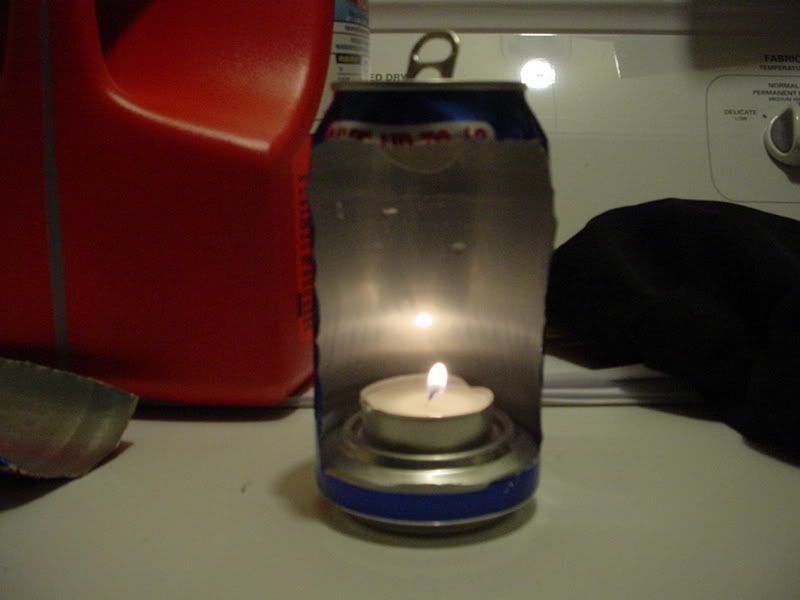
I got this idea from the DIY Vietnam Lantern post in the Arfcom Survival Forum. It cost nothing and the only tool I used was the blade on my Swiss Army knife.

You need two soda cans. Cut away most of one side of the first can. Next, cut the bottom off of a second can about 3/8" above where the wall and the base meet. Put the cut off bottom inside the first can and place a tea light in the center recess.


And a second shot with the lights out:


The silver inside of the soda can maximizes the limited amount of light you get from a candle or tea light and shields it from drafts. Note that the can does get hot so be careful if you pick it up. I wouldn't walk around with this, since if you trip you'll be dropping a lit candle and could start a fire. But for emergency use in a power outage, or placed on the dashboard of a snowbound car, it would be handy. (Make sure you crack a window if you're using it in a car.)

Sunday, January 07, 2007

Will your phone work with the power out?

Will your phone work with the power out?

Old fashioned line-powered phones don't need an external power source. They get their operating power right from the phone line.

However, most of us have cordless phones with a base station and one or more handsets. Many of us use VOIP phones, such as Vonage, which use our Internet connection. No line power there.

The easiest way to ensure you have a working telephone during a power outage, if your phones are not line powered but you still have regular phone service, is to keep a line powered phone around. You can pick them up cheap at Lowe's or Home Despot for around $10 each. If you have VOIP service which depends on an Internet connection*, then you need a battery backup, AKA uninterruptible power supply.

You can buy UPSes meant for computers and networking gear at places like Staples, Office Depot, Microcenter, or CompUSA. Well known, reputable brands include Belkin, American Power Conversion (APC), and Tripplite. Prices will range from a low of around $30 to enough to melt your Master Card.

UPS capacity is measured in Volt Amps (VA). The more the VA, the longer you'll have power available. How long it'll last depends on what you have connected to the UPS. E.g., if you keep surfing the web on battery backup it's going to kill your battery sooner than if you have only your Vonage router and cable modem connected.

Note that some equipment will continue to draw power even if the power switch is off. E.g., most recent PCs have a power switch on the front of the case and a second one on the power supply in back. If you leave the PC connected to the UPS, it'll continue to draw a little bit of power unless you unplug it or turn off the switch on the power supply in the back of the case. I also recommend against plugging printers and scanners into a UPS because of the potential for draining the power, especially if the printer/scanner is on and the power goes offline when you're not home. Plug printers and scanners into surge protectors, which are plugged into mains power.

If a power outage lasts more than a day or two it's likely that the UPS will run out of juice. But if most power outages you experience are short term, a UPS is a worthwhile investment to keep your primary means of communication open.


* ISPs have their equipment on massive battery backups and/or backup generators, so they often stay online during power outages. ASSuming that the cables haven't been knocked down, you can usually get online if you have backup power.

Monday, January 01, 2007

Thoughts on Selecting .22 Rimfire Ammunition

Most preparedness-minded people will have a least one .22 around. They are excellent for small game hunting, target practice, plinking, training new shooters, vermin control, and can be pressed into use for defense. However, many people fail to properly select the best ammunition for their .22s, focusing instead on price alone. In this post I'll discuss some criteria for selecting the best .22 ammo, focusing on .22 Long Rifle.

Rifles and pistols chambered for .22 Long Rifle can safely chamber and fire the following cartridges:

  • .22 BB Cap (mostly unavailable)
  • .22 CB Cap (available in both Short and Long cases)
  • .22 Short
  • .22 Long (No longer very common)
  • .22 Long Rifle in both standard velocity (subsonic) and high-speed.
  • .22 LR Shot (I haven't tried these so won't comment further.)

There are "hyper velocity" .22 LRs like CCI Stingers and Velocitors, and Remington Yellow Jackets and Vipers. Conversely, there are standard velocity rounds intended for hunting, e.g., CCI Subsonic HPs and Aguila Sniper Subsonics. The latter is a .22 LR length round, but loaded with a heavy 60 grain bullet in a .22 Short case.

Most .22 LR semiautos will function only with Long Rifles. The other rounds won't have enough power to function the action. The Remington Model 572 is a notable exception, being designed to function with Shorts, Longs, or Long Rifles. Sometimes, manually operated repeaters won't function with anything other than LRs either. However, they'll work as a single shot if you load the round directly into the chamber.

Standard velocity rounds, especially hollowpoints or solids which have been flatnosed, work well for small game hunting with good shot placement. They are quieter than high speed loads and often are more accurate.

For controlling vermin larger than rats, high speed or hyper velocity hollowpoints work better than standard velocity loads, except for the Aguila Sniper Subsonics. .22 LR can be used on varmints up to the size of woodchucks and racoons, but shot placement is key. I've seen a rabid raccoon that weighed about 15 lbs absorb over a half dozen high speed hollowpoints PLUS 5 standard velocity solids without expiring. These were all hits in the chest cavity from no more than 10 - 15 yards. A shot through the brain was required to finally kill it.

Small vermin such as rats can be taken care of with standard velocity loads, .22 Shorts, or even CB Caps. I have a couple of boxes of CCI .22 CB Longs that I keep around in case this is necessary. Fired from a rifle, they are about as noisy as an airgun. In other words, pretty darn quiet.

While it's better than nothing, a .22 is not a good choice for defense against people. It simply doesn't have enough bullet mass to reliably stop an aggressor. See my comments about the rabid raccoon above. The light weight, relatively low velocity bullets don't pack enough punch to reliabily penetrate to an attacker's vitals and cause enough damage to force him to stop. That said, high velocity solids would be my choice if I needed to use a .22 for defense; the specific load I'd want would be CCI Mini Mag solids for both its relatively good penetration and CCI's high quality. The only time I'd recommend a .22 for a defensive gun would be for someone who can't handle anything bigger. But, if push came to shove in a worst case scenario, and a child needed to help defend the homestead, then something like a 10/22 with a full load of Mini Mags beats a sharp stick.

The best accuracy will almost always be obtained with some kind of .22 LR ammo. When fired in a LR chamber, bullets from .22 Shorts have a long jump from the case to the rifling, which hurts accuracy. The rounds that a given gun will shoot the most accurately can only be determined by trying a variety of ammo. I recommend buying a 50 round box or two of several kinds of ammo and shooting them at a paper target from a bench, to see what the gun likes best. Shoot at least a couple of targets, at least one of them at 50 yards, to see how individual loads work at a distance.

Shooting for accuracy out to 50 yards is especially important with the Aguila Sniper Subsonics. The heavy 60 grain bullets pack a wallop but are often unstable in .22 rifles with the standard 1-in-16" rifling twist. Since they are somewhat expensive, it's a good idea to test a box to see if they'll shoot acceptably in your gun before acquiring a substantial quantity.

In my experience, the most uniformly accurate and high quality .22 LR ammo (other than specialty target loads like Eley Tenex) is made by CCI. I used to favor Winchester PowerPoints, but had several duds in one brick. I've never had a CCI .22 fail to go off. CCI Mini Mags and Subsonic Hollowpoints function well and shoot accurately in all of the .22s in which I've tried them, including a Ruger 10/22. Savage Mark IIGL, S&W Model 18, Ruger Single Six, and a Winchester 9422.

I recommend storing rimfire ammo in an airtight ammo can, either a GI surplus can or something like an MTM Sportsman's Dry Box. Rimfire ammo is not as well sealed against moisture penetration as centerfire ammo, and if the ammo gets wet or is exposed to humidity for a long time it may go bad.

Hopefully this post has given you some food for thought regarding .22 rimfire ammunition selection. Please share your insights in the comments.
Wednesday, December 27, 2006

Got another Ruger Mini-14

(Cross-posted from Blog O'Stuff.)
It was cold and windy today so I didn't feel like hitting the range. I did however, go up to Surplus City with a couple of guns which I haven't shot in quite awhile, and did some trading. In exchange for my EMF/Rossi Hartford Model 1892 and my Ruger GP-100, plus some boot, I picked up a used stainless steel Ruger Mini-14 GB. It's a 186-series piece. It came with one Ruger factory mag (stainless, no less) and I bought two more Ruger factory mags, both used. (I figure I should get as many evil high capacity magazines as I can while the getting is still good.)

The GB or Government Model differs from the standard Mini-14 with the addition of a flash suppressor screwed onto the muzzle, and a winged front sight several inches back. The front sight block also has a bayonet lug, and the gun will accept standard M-16 bayonets. (Raspberries to Senator Feinstein and her partners in crime.) The GBs were never intended to be sold directly to the public by Ruger, but a fair number of them have become available as police or prison guard trade-ins, as many departments "upgrade" by replacing their Mini-14s with AR-15s.

I really like Mini-14s. They are not as accurate at AR-15s (at least without serious tuning) but they are very simple, ergonomic, and reliable little rifles. Mini-14s are accurate enough for their intended purposes -- potting varmints around a farm or as a social carbine out to a couple of hundred yards.

Getting back to the reliability aspect -- Mini-14s are much less finicky when it comes to maintenance or quality ammo than AR-15s. For example, Wolf .223 doesn't run well in my Colt AR-15A3, but runs just fine in my 182-series Mini-14. I expect it to work fine in the GB. A couple of features which help the Mini-14's reliability are (a) the fact that it taps more than enough gas from the barrel to work the action, and (b) fouling stays out of the action. IOW, it doesn't have the "shits where it eats" problem of the AR-15. Note that the AR-15's direct-impingement (DI) gas system can be reliable, but it demands more cleaning, and that more recent military rifle designs all use pistons, not DI.

One of my online friends used a stainless Mini-14 in Alaska for many years, taking a large number of deer and other game with it. It stood up to harsh conditions well and he still has the rifle, now that he's retired to WV. .223 isn't really a deer caliber but it will do if you take your time and place the bullets right. Perhaps surprisingly to guys in the lower 48, but the Mini-14 is one of the most popular bush guns in AK. It and it's ammo are light. It's reliable and easy to maintain, and has minimal recoil, so a lot of Alaskan natives like it. A stainless Mini-14 in a plastic stock would be a heck of a good choice as a defensive carbine, especially if you need one to keep on a boat.

Sunday, December 17, 2006

FCC Drops Morse Code Requirment for Ham Radio

The FCC is finally dropping the Morse code (AKA "CW") requirement for all classes of amateur radio license. The official license is here (PDF document). The international governing body for amateur radio dropped the requirement several years ago, and several countries had already followed suit, e.g., Germany and Italy, IIRC.

IMHO, this is a good thing. CW is a mode of operation, not a guarantee that someone isn't a schmuck. Yes, CW is useful and I'm glad that portions of the bands are still reserved for CW. But not everyone is interested in it, and many people just cannot learn it even with a lot of study. I've spoken with several General Class hams who've not used it since getting their license. Operators will still need to pass the written exams on radio technology and proper operating procedures before getting a licence.

One reason many hams didn't want the code requirement dropped is because CW can get through poor conditions better than voice on AM or Single Side Band. However, there are new operating modes, such as PSK-31, which use as little bandwidth as CW, perhaps even less, so they work as well in adverse conditions as CW. (I'm especially interested in PSK-31 since it's a way to bridge my interests in computers and radio.)

Time for me to start studying for the Element 3 exam.

Wednesday, December 06, 2006

In Praise of the Non-Tactical Pocketknife

For most of the past 10 years my pocketknife has been a "tactical" folder. First, it was a Spyderco Delica. When I lost the Delica (found it 3 months later) a few years ago, I replaced it with a Benchmade Griptilian. I've been very happy with both knives. They are well made, hold a nice edge, lock securely, and need only one hand to open.

Last weekend I dug out my old Victorinox Pioneer Swiss Army Knife (SWAK). I've had this since sometime in the early '80s. Unlike the current production silver-colored Pioneers the aluminum handle scales on mine have a red oxide finish. It has a spear point blade, bottle opener, can opener, large and small screwdriver blades, a wire stripper notch on the bottle opener, a reamer/awl, and a key ring. It's the same as the real issue SWAK or "Soldier," with the exception of the key ring. Picking up the Pioneer felt like getting reacquainted with an old friend.

I carried my SWAK for years. It accompanied me on a six week trip to Europe in 1984, following me behind the Iron Curtain into Hungary and Yugoslavia and back. I've used it to cut stuff, tighten and loosen screws, pop open sodas and beers, and poke holes in things with the reamer. In other words, it can do a lot more than a knife with only a blade.

My job is in an office pushing bits and bytes around. Dress is business casual. I'd look goofy with a multitool on my belt. Like it or not, fashion can influence knife choice. (And I'm hardly a fashion plate.) And as for tacticality, the closest I have to training in knfe fighting is a semester of fencing in college, close to 20 years ago.

So, Sunday I checked the edge (still shaving sharp after a few years languishing in the handlebar bag on my mountain bike, out in a shed) and sprayed out some dust with some Superlube dry teflon lubricant from a can, and since then I've been carrying the Pioneer instead of my Benchmade. It fits nicely in my pocket like it belongs there and offers more functionality than the Griptilian. The only real advantage the latter has is one-hand opening.

I'm liking having my old friend with me once again. I may even order another one or two to stash away for the future or in an emergency kit.

Monday, December 04, 2006

Power Failure

Getting my ham radio setup with a battery backup came not a moment too soon. Friday night, the power went out.

Last Friday we had a cold front come through, bringing with it high winds. About 2030, the wind blew one of the trees in our yard into the power line feeding us from the pole. Sparks, pops, and groaning noises followed and the power went out.

Out came the flashlights, candles, and my D-cell powered Coleman flourescent lantern.

My wife called PECO and reported the outage. We use Vonage for our phone service and my home LAN is on two APC UPSes so we had phone service and cable modem Internet access until I shut them off to conserve power. In the meantime, we had our cell phones if we had needed to call anyone.

At about 2200 - 2230 we got some power back. A couple of the circuits came back but we had no power upstairs in our bedrooms, nor for the heater (natural gas but the blower requires electric). If things had gone on longer than they did we could still use our gas fireplace, however. Fortuitously, the refrigerator was on a circuit with power.

Meanwhile, I spent some time on the radio and caught the tail end of a Skywarn net. The PowerGate/gel cell setup worked perfectly. I'd done a test run on battery power last Thursday night when I checked into the MARC club net, and got good signal reports.

Saturday morning at about 0930 PECO tech came out. He went and looked at the pole and saw a mass of vegetation which had grown up along it, and that the insulators separating the three feed lines were broken. Due to the vegetation he needed to call for a crew to come out, climb the pole, and defoliate, then fix the connection. (A crew was out over the Summer clearing vegetation away from the wires and pole in my neighbor's yard but apparently they didn't get enough.)

The reason we had some power was that we were getting 110V into the house, not the full 220V. He jumpered the live 110V part to the other part, so we at least had 110V throughout the house, enough to run our heater.

An hour and a half later the crew showed up. They ended up replacing the line from the pole to our house, but I'll need to have an electrician replace the feeder line from the head to the service. (Good thing I have a close friend who's a master electrician.) However, they had to shut power back off for a few hours while they worked. We were back to status quo ante around 1500 Saturday.

Yesterday I went and pruned the tree which had swayed into the line. I'm hoping the reduced wind load will make it steadier. If it does sway or fall it shouldn't take out the power, however, since the PECO crew Saturday rerouted the line. It will drop the currently-unused Verizon phone line, and the heavily-used Comcast cable line, so I do want the tree removed fairly soon.

Wednesday, November 29, 2006

WMR PowerGate 40 Backup Power System

A major reason I got my ham ticket was because I wanted emergency communications. I have a pretty good home setup for VHF/UHF in the form of a Yaesu FT-7800R hooked up to a Comet GP-3 antenna on my roof. What I haven't had, up until now, is some form of powering the radio if the power goes out.

Early last week I placed an order with West Mountain Radio for a few items:

  • A PWRGate PG40 backup power system.
  • An MK brand 73 amp hour gel cell.
  • Cables to connect the PowerGate to my Yaesu power supply and to the gel cel, along with my FT-7800R and VX-5RS HT.

The PG40 and cables came the next day but the gel cel didn't arrive today; it's dropped shipped from the manufacturer's warehouse.

The PWRGate has three power connectors:

  • Power in from a DC power supply, which in turn is plugged into mains power.
  • Power out to the radio.
  • Power to the battery for a trickle charge. This port also accepts power in from the battery.

The connectors are Anderson Power Poles.

During normal operation with mains power, the PWRGate provides a trickle charge to the gel cel and DC to the radio. If the battery drains down it could take a few days to recharge once mains power returns, so at some point I'll get a separate battery charger.

If the mains power goes out then the PWRGate's internal switch reconfigures the unit to take power from the battery and provide it to the radio. The power source transfer is seamless, requiring no user intervention, and when I tried it out I didn't notice any difference in the audio I was listening.

The reasons for using a gel cel are that (a) they're safer than lead acid batteries that you need to worry about keeping equalized since they are maintenance free, and (b) they are rated as spill-proof and don't give off fumes. Being a deep cycle battery, it can safely be discharged down to a low level without harm.

Here's a pic of my setup:


The PWRGate is the finned black thing sitting on top of another black box, which is my DC power supply. The leftmost cord plugged into the top is the power input, the middle is power to the radio, and the right hand one goes to the gel cel. The black square on the red cable to the cel's positive lead is a fuse holder. (I have a temporary cover over the gel cel as a protective measure so nobody accidentally shocks himself.)

Future refinements to this system will include a battery box to protect the gel cel and anybody who get a bit careless, a battery charger, and a cable with Anderson Power Poles on one end and a cigarette lighter receptacle on the other so I can power 12V devices including charging cell phones.

Tuesday, November 21, 2006

Backup Radio Power

The major thing missing from my ham radio setup has been a backup power source. With Winter just around the corner I decided that it was time to remedy this. Today I placed an order with West Mountain Radio for several items:

  • PWRgate 40 package
  • 73 ah gel cell
  • Cable for my VX-5RS
  • Cable for my FT-7800R

The cables have an Andersen Power Pole connector on one end, for plugging into the PWRgate, and the appropriate connector on the other end for plugging into the radio.

The PWRgate allows one to create an uninterruptable power supply for radios. Ugly ASCII diagram:


[A/C power] – [PWRgate] – [Gel cell]
|
|
[Radio]

This provides the same basic functionality as a UPS intended for computers. If the mains power goes out an you're using the radio, it will automatically shift over to the gel cell. While the radio isn't being used, it will trickle charge the battery.

My Yaesu FT-7800R consumes only 0.5A in RX mode (squelched) and 8.5A when transmitting, so if I'm just monitoring during a power outage, the 73 ah gel cell should last quite awhile. My VX-5RS HT uses a max of 1.9A when transmitting, so it'll last even longer.

At some point I may invest in a generator but for now our power is sufficiently reliable that I don't feel the need yet.

Monday, November 20, 2006

Cross-platform encryption

I want to save digital copies of important documents on a USB stick, but want to secure them against unauthorized access if the drive gets into the wrong hands, because it would be an identity thief's wet dream. The stick will be part of my household emergency kit.

Today I discovered jFileCrypt, a cross-platform encryption/decryption tool written in Java, and which can run on any platform with Java 5. Aside from the fact that it's free (GPL) software, being platform-independent is what I really find attactive. JFileCrypt supports Blowfish so the resulting encrypted file should be secure.

Alternatives include Mac OS X's built-in ability to create encrypted disk images and GPG. Unfortunately, an ecrypted Mac disk image isn't cross platform, and GPG can be confusing, although I've been playing around with it and I'm getting a better understanding of it. For Windows and Linux users, TrueCrypt looks like a good alternative.

Ideally, I'd like to have an ~500 MB encrypted file or folder on a 1 GB USB drive. On the unencrypted portion I'll keep a copy of the encryption utility so that if necessary, I can decrypt the information even if I don't have access to one of my computers. The password I'll be using is long, non-obvious, and has zero significance to anyone other than me.

If any of my readers have suggestions for cross-platform encryption software that would be suitable for this application, please post them as a comment.

Wednesday, November 15, 2006

Good 2M Propagation Tonight

So I'm sitting here in Plymouth Mtg., PA scanning through the freqs on my radio and I picked up the Carbon County ARES net coming in loud and clear. Their repeater is located about 60 miles away in Jim Thorpe, PA. I checked in and introduced myself. Net control gave me a good signal report, even though I was transmitting with only 10W. According to him, there were some "scrambled eggs" in the background but I was totally intelligible.

Even though VHF FM is often said to require line of sight, there are a lot of hills between the repeater and me, so I think the knife edge effect is in play.

My rig is a Yaesu FT-7800R 2M/70cm dual bander, with a Comet GP-3 antenna on top of a 5 foot mast on the short chimney sticking out of my roof.

A few minutes later a station from Sussex County, DE checked in and reported that he too was hearing the repeater clearly. He noted that he also was able to bring in Martinsburg, WV shortly beforehand. Impressive!

Nice to know I can communicate out that far without much infrastructure (or will be, once I get a battery backup in place for my shack).

Tuesday, November 14, 2006

When the lights go out

Back in August I posted about coming shortfalls in reliable electrical power.
...

The [Electric Reliability Organization] projects that U.S. demand will increase by 141,000 megawatts (MW) over the next 10 years. Supply, however, will increase by only 57,000 MW, and that assumes that all currently proposed new facilities are approved and built.

The system will be operating below the marginal capacity needed to ensure supply reliability at all times. In other words, in peak periods like heat waves, there won’t be enough electricity to go around. Blackouts will inevitably result.

...

Read the rest of the article here. [H/T to InstaPundit.]

Now, it won't be the end of the world if this comes to pass. However, reliable electricity is something that most Americans have come to expect as a given, much as if it was air. It will take getting used to, and points to the value of implementing alternatives for when grid power is down.

Thursday, October 26, 2006

NRA Survival Toolkit

I got one of these last week. It contains a Blastmatch fire starter, a couple tinder cubes, a whistle, and a signal mirror. It's packed inside a Pelican-type plastic case. There's some foam padding in there that's unneeded IMO, so I plan to remove it to add additional items. E.g. a pill bottle filled with vaseline impregnated cotton balls for use as tinder.

For the price it's a steal. The Blastmatch alone normally goes for what the kits lists for. Even though it's at the NRA Store, AFAIK you do not need to be an NRA member to order from them. (That said, JOIN THE NRA if you haven't already.)

Sunday, September 24, 2006

Outdoor Products Power Pack

After last week's fun in center city Philadelphia I decided it was time to redo my get home bag (GHB). My GHB is actually my laptop bag, so it needs to securely hold my G4 iBook in addition to providing room for normal GHB stuff. I've been using an REI Big Byte computer backpack but wanted something a bit larger with better designed pockets.

Yesterday I went to REI and bought an Outdoor Products Power Pack in black. I used Outdoor Products backpacks in high school, college, and law school as book bags and was not nice to them. They shrugged off all the mistreatment I dished out and were no worse for the wear, except for getting dirty. The bag I used in law school is now the GHB in my truck.

Anyway, the Power Pack seems well made like my older bags. The pockets are well designed for a laptop bag and there's plenty of room to carry survival and first aid supplies. The shoulder straps are well padded, as is the back, and there's a sternum strap for long hauls. There's a mesh bottle pocket on the side which will hold a 32 oz. Nalgene. On front there's a place to stash a jacket, held in place with mesh and straps with a Fastex buckle.

It's not tacticool but it looks like a good choice for those of us stuck working in the city.

Thursday, September 21, 2006

Minor SHTF in Philly Today

We experienced a minor SHTF event today in Philadelphia due to an electrical fire and explosion on south 15th Street, very close to City Hall. I work in a high-rise at 15th & Market, right near the epicenter. I later found out that a 36-square block area was closed off to traffic and about 5,000 people had to evac the immediate area.

Around 1300 we heard a kaboom. For the next 10 - 15 minutes everyone was wondering what had happened. At about 1315 the message was passed to evacuate the building. For some reason the fire alarm was not activated nor was the building’s P.A. system used. Rather, the floor captains were telling everyone to leave. They have Blackberries to send and receive text messages in emergencies.

Shortly after the kaboom I grabbed my stuff and made to ready to evacuate in case the order was given. I got my jacket and bag ready and shutdown one of my PCs. So, when we finally were told to leave all I had to do was to close my laptop and put it in my bag, put on my jacket, and go.

A few things disturbed me about how the whole thing was handled and I intend to (nicely) speak to our HR person tomorrow. First, within a few minutes of the kB, I saw one of our floor captains leaving the building. Considering that it’s a floor captain’s job to make sure that everyone is out, I regard this as abandoning her post. Her panicked reaction demonstrates that she’s unsuited for the role.

Our other floor captain performed his job but left his emergency bag behind, which he immediately regretted. The floor captains’ emergency bags contain stuff like a hard hat, megaphone, flashlight, etc.

Also, although we had fire drill on Tuesday, today’s event was a real cluster. Communication was fragmented, nobody responsible thought to activate the fire alarm, and no use was made of the building’s P.A. system. When people were told to leave the building they weren’t told where to go until after milling around outside for about ten minutes.

Natually, the rumors started flying immediately. The first was that the boom was due to a gas leak, and it wasn’t for awhile that we heard the true cause.

I carry some basic survival supplies in my bag: water bottle, a snack bar, small first aid kit, bandanna, Gerber Multiplier, chemlight, Princeton Tec LED flashlight, poncho, and a space blanket. I’m strongly considering adding my Yaesu VX-5RS ham radio which has wide-band receive, although I've learned that Philadelphia recently implemented a trunked Motorola system for the police and fire departments, so I'm not sure how useful it would be.

Monday, September 18, 2006

Preps to keep in your vehicle

Having just returned from an overnight trip to Arlington, VA, I am prompted to discuss things that should be kept in a vehicle to help deal with emergencies on the road. The possibility always exists that you’ll run into a mechanical failure which requires dealing with, or outside emergencies. Keeping a bag or box in your trunk or behind the seat of a pickup can make life a lot easier in the event of an inconvenience, or save a life in an emergency.

For dealing with mechanical issues I keep several items in my truck:

  • Some basic hand tools

  • A spare quart of motor oil

  • A jug of antifreeze

  • A jug of windshield wiper fluid

  • A D-cell flashlight

  • The factory jack

  • A can of WD-40

  • A few shop rags, a roll of paper shop towels, and waterless hand cleaner wipes

  • Jumper cables

  • A few magnesium road flares

  • 12VDC air compressor/flashlight

  • A can of Fix-A-Flat
  • Four-way tire iron

To deal with other issues I add:

  • A Kershaw lock blade knife

  • A Gerber Multiplier Scout multitool

  • CB radio (also handy for real-time traffic reports)

  • My everyday carry cell phone

  • First aid kit

  • Rain poncho

  • Space blanket
A lot more stuff could be added, and this list would be expanded if I didn't live in a large metro area.

Out trip remained within heavily-travelled areas so I wasn’t worried about taking anything for an overnight stay in the boonies, like the BOB shown in this post.

I normally also carry a get-home bag with additional supplies including an MRE, water, another poncho, compass, etc. but had to take it out for this trip since we were short on space. I need to change some of the contents and downsize it into a smaller bag. That will be a project for a future post.


Tuesday, August 29, 2006

Nuclear threats making a comeback

As the US and the UN seem unable to contain Iran's nuclear ambitions, we have to prepare ourselves for an unsettling future. Unlike the Soviets and Chinese, we can't count on the Iranians or other Islamic fundies to whom they might pass a nuclear device to behave rationally. MAD is not a viable strategy when your enemy welcomes death as the way to be with God.

Domestically, a nuclear Iran and proliferation in the Muslim world may politically destroy the left wing of the Democrat party, especially if a nuke gets used.

There's some excellent discussion of the issue here. I think I'll order a copy of this, as well.

Sunday, August 27, 2006

Diamond MR77 Mag Mount Antenna Review

Awhile ago I bought an MFJ Powergain mag mount antenna to connect to my Yaesu VX-5RS 2M/440MHz/6M HT while in my truck. Unfortunately, it didn't work well for me in that role, vibrating itself to uselessness in short order. So, a couple of weeks ago I ordered from Gigaparts a Diamond MR77 as a replacement.

My first impression of the Diamond upon opening the package was favorable. It seemed better made than the MFJ. E.g., where the coax goes into the base it's reinforced with one of those flexiible rubber things like you see on some power cords. When I screwed the antenna on it seemed more solid than the MFJ.

One thing I did the night before putting the Diamond on my truck was to seal anywhere it looked like water might be able to get in. Based on my prior experience with mag mount antennas like the MFJ and a couple for my CB, water can get in through joints and then you get rust, causing performance to deteriorate. The sealant should also help keep the antenna itself screwed down tight to the mount. I used liquid electrical tape as the sealant.

Yesterday I finally got to try the MR77 and I am very pleased. I was able to hit the MARC repeater in Paoli, PA from near Willow Grove, a distance of about 20 miles, using 5W. I had a QSO with another MARC member on my drive home and while it wasn't full quieting, the audio was perfectly intelligible.

Aside from vehicular use, mag mount antennas can be used at home or in the field if you put them on top of a metal object to act as a counterpoise. For example, you can place it on top of a metal cabinet, an ammo can, a steel garbage can lid, or a cookie sheet.

Tuesday, August 22, 2006

Firesteel Scout

Over the weekend I picked up a Light My Fire Firesteel Scout at REI and tested it with several different kinds of tinder. It is basic “flint” and steel system for generating sparks to start fires. The striker is a small piece of flat steel, while the “flint” is a ferrocerium rod or something similar (REI's site says it's magnesium but I think that's wrong) with a small plastic handle. The flint is like those found in the magnesium fire starter blocks. It requires two hands to use, unlike a Blastmatch. The striker and flint are connected with a piece of nylon cord.

The Firesteel Scout throws a good shower of sparks. Among the different kinds of tinder I tried to catch those sparks and start fire with, were dryer lint, a pinecone oozing resin, a used dryer sheet, jute twine, and a cotton ball impregnated with Vaseline.

Any of these items would've worked fine with a match or butane lighter. However, using a flint and steel system requires tinder that's easier to ignite. The dryer lint worked OK but burned too fast. The dryer sheet worked well once I rubbed some resin from the pinecone onto it. Without the resin it didn’t work at all. The pinecone wouldn’t ignite from just sparks. Unraveled jute twine with pinecone resin rubbed on worked very well. The cotton ball with Vaseline worked into it and then teased out worked extremely well.

I also tested jute twine which had been soaked in the melted wax from a citronella candle bucket. Once unraveled it caught sparks well and burned long enough to ignite other items, like a pinecone. I cut a bunch of 2” – 4” lengths of the twine and soaked them in the melted wax, and have them stored inside a small aluminum canister.

Soaking in the citronella wax is also an easy way to waterproof matches, instead of setting up a double boiler to safely melt paraffin. Just do it outside so you don’t stink up your house. Aside from waterproofing the matches, the wax melts when you light the match and if you're careful, will drip into the tinder you're tying to light, making a bigger flame.

Wednesday, August 16, 2006

Thoughts on Electrical Power

Last night I attended the monthly members' meeting of the Mid Atlantic Amateur Radio Club. Rather than a presentation on some radio-related topic, last night's speaker talked about how electrical power is generated in the Greater Philadelphia area. The presenter was member who's an employee of PECO Excelon.

Interestingly, a bit over 50% of our power in this area comes from nukes: Limerick, Peach Bottom, and Three Mile Island. Most of the rest comes from hydro (e.g., Conowingo Damn) and coal (e.g., Eddystone).

The nuclear plants are run to capacity most of the time. Their cost per kilowatt hour is the cheapest, and they are the cleanest. For example, Peach Bottom has been in operation for over 30 years and all of the spent fuel is still kept onsite. It's also extremely hard on nuclear plants to bring them back up to full power after being slowed. The coal plants, being the dirtiest, are spun down during off-peak hours.

Part of the presentation discussed deregulation in the power industry. A more accurate description would be reregulation. What's been deregulated has been the ability to open a power generation plant. Distribution of power and the price it sells at is still heavily regulated. The result of this is that although some other companies got into the power generation business the market is not allowed to go through its natural cycles due to the regulations covering how power is sold. So, the barriers to entry remain very, very high.

One tidbit caused me a bit of concern. During our most recent heatwave, PECO's reserve capacity fell to about 10%. I.e., peak usage hit about 8800 megawatts and there was only another 10% capacity to back it up in case it went higher. Fifteen percent is considered the comfort zone. Conserve all you want but society's power demands never drop, they only go up over time.

Natural gas fired plants aren't economically viable for picking up more of the load due to the spikes in natural gas prices over the past year or so. Same for oil. Wind isn't a real option in PA because it's just not that windy and it's very inefficient. Solar is so prohibitively expensive and inefficient that it's not worth considering. That leaves coal and nukes.

If Pennsylvania has one thing in abundance (besides crappy pro sports teams) it's coal. The downside to using coal is that it's dirty. There are designs on the drawing boards which employ coal gasification to extract the volatiles from coal before it's burned. The coal gas is then further processed to remove pollutants like sulfur -- which can be sold -- until what's finally burned is basically hydrogen. This sort of a plant is more a chemical processing facility with a power generation plant attached to it than a pure power plant. Still, it may be a way to wean us off some of the foreign oil we're so dependent upon.

Nuclear plants are clean and safe, rantings of enviroweenies to the contrary. Spent fuel can be safely stored onsite for a long time, as at Peach Bottom, or buried in Yucca Mountain. Or, as Jerry Pournelle has pointed out, the spent fuel can be disposed of by dropping it into a subduction zone where it can be returned to the Earth's crust. This is one area where France is getting it right, as is Japan.

There hasn't been a nuclear plant built in the USA in 30 years, largely due to all the bureaucratic red tape imposed by the Feds. Plenty of nukes are being built in France, Japan, Finland, and other countries, however. Apparently, some power companies have gotten together with the intention of pooling their resources to build new nuclear plants.

My concern is that since it takes anywhere from six to ten years from the inception of a plan to build a power plant until it starts generating, we may see power shortages spread beyond California to other parts of the country before they are online. There are some things you can do in your home in the meantime to help you get past brownouts or blackouts:

  1. Better insulate your house.
  2. Replace drafty windows with modern two or three pane windows.
  3. Replace incandescent lights with compact flourescent bulbs.
  4. Install an attic fan and/or ridge vent if you live in an area where it gets hot in the summer.
  5. Get a secondary heat source in case outages occur during cold weather. E.g., a wood stove or a kerosene heater.
  6. If you have things that must be kept refrigerated, invest in a generator and/or backup batteries that can get you through a blackout.
  7. Place household electronics on line conditioners or better yet, uninterruptable power supplies.
  8. If you have a two way radio for emergency communications, get some kind of alternate power system (solar, batteries, genset, etc.) for when the power goes out.
Doing 1 - 4 will start saving you money now. At our home we've done 2 and 4, and made progress on 1, 3 and 7. I don't currently have anywhere to store a generator so that's going to have to wait. I'm currently looking into different options for number 8.